Circular Economy in ASEAN: A Brief View on Plastics Harmonization and Micro, Small, and Medium-sized Enterprises Inclusion

Written by: Muhammad Rasyid Ridho

On 18 October 2021, ASEAN’s Framework for Circular Economy for the ASEAN Economic Community (AEC) was promulgated at the 20th AEC Council Meeting. It signifies the importance of the circular economy (CE) as part of the AEC. This system is ostensible as an environmental-friendly alternative. However, ASEAN’s decision on this issue after six years of AEC establishment brings a simple question, what does “CE” mean, since it is quite a novel term for this region? Besides, how will this concept fit into the more extensive framework of AEC?

There is plenty of definition regarding CE. The most popular one is from the Ellen MacArthur Foundation (2012), a restorative industrial economic system to ensure the effective flow means of production and rebuild the used resources. The very purpose of this approach is to “close the loop” of the production process for attaining sustainability of the environment (Winkler, 2011). The “closure” is needed since the “linear economy” prevails as the major production process, which is characterized by “take-make-dispose”, dependent on new material use, and with no concern for the potential value generation of waste, which leads to the accumulation of waste as its negative consequence (Rathinamoorthy, 2019). The basic principles of CE are reduced, reuse, and recycle, sometimes with other additions such as repair, refurbishment, remanufacture, and repurposing.

Indeed, there are already many attempts from Southeast Asian scholars to explain CE. Most of the research is focused on its technical implementation and potential in the future in various fields. The level where it is operated also ranges from the village to the national level. However, despite the different nature or scopes of those research, it is to be noted that several kinds of research from these countries bring out similar tone-related factors of CE adoption and the recommendations. In the factors of adoption or consumption, it includes the willingness of stakeholders, personal attitude, economic cost and benefit, public acceptance or support, government incentives and support, company culture, and consumer demand (Pasaribu, 2006; Ngan et al., 2019; Jan 2022; Gue et al., 2020; Akkalatham & Taghipour, 2021; Piyathanavong et al., 2021; Tseng et al., 2021; Abbasi et al., 2022).

These researches also point out the recommendations such as: putting the commitment into long-term legal, regulation, and masterplan favoring CE with its enforcement; giving incentives in the forms of funding, grants, or tax to practicing-CE enterprises; raising public awareness; coordinating between stakeholders (between government agencies or government-private-society); campaigning awareness; and supporting research and development (Pasaribu, 2006; Ha, Levillain-Tomasini, Xuan, 2019; Wichai‑utcha & Chavalparit, 2019; Adi & Wibowo, 2020; Abdul-hamid et al., 2020; Dung et al., 2020; Dung & Hong, 2021; Hoa & Khanh, 2021; Khor & Teoh, 2021; Taghipour & Akkalatham. 2021; Vân, 2021; Vu et al., 2021; Bueta, 2022; Mangmeechai, 2022). While these researches are conducted in different countries, which automatically only puts emphasis on their respective countries. Thus, there is still a limit on how CE could be seen from a regional perspective. In addition, the other CE common principle that is being implemented in these countries is the 3R (reuse, reduce, recycle) approach (Rahmadi, 2020).

As explained by Anbumozhi and Kimura (2018), while the linear economy is the motor of ASEAN growth, it cannot solve the problem of diminishing natural-nonrenewable resources, inequality, and climate crisis. It has become one of the reasons why the Framework of CE was recently promulgated. Of the strategic priorities contained in the Framework, one that needs to be put into focus is standard harmonization. It is deemed necessary to fulfilling this aspect in the right platform and focus because its absence would be one obstacle to further coordination of regional CE practices, which possibly lead to deeper regional integration in the future (Kojima, 2019).

However, since there are a lot of areas in which sector needs to be great, thus ASEAN perhaps could pick an urgent sector on which it needs to be focused. Regarding this issue, then revisiting the report of Akenji et al. (2019) would be appropriate since their report brings a fresh outlook on regional CE practice, especially on the issue of plastic. He proposes several points regarding the position in which ASEAN could involve, which are: a regional guideline of plastic use; a network of research and development; technical standards for products and recycling; agreement on plastic pollution. Plastic waste has become an issue due to the total ASEAN contribution to plastic waste is 31 million (Trajano, 2022). The timing could not be better; in the same year, ASEAN announced the Framework of CE in AEC and the ASEAN Regional Action Plan for Combating Marine Debris in the ASEAN Member States (2021-2025. The framework could serve as a big umbrella, and the action plan complements the specific aspect. Thus, integrating these two frameworks should promote CE as the long-term remedy for the plastic problem.

It is mentioned briefly in the Framework that micro, small and medium-sized enterprises (MSMEs) are considered on CE practices in ASEAN. The inclusion of SMEs is essential due to their vast numbers in the region, which is approximately 71 million (Tan, 2022). They contribute 97% of total business activity and employ 67% of the working population (Tan, 2022). It is found that enterprises which implement CE practices are more resilient to global economic shocks than others due to their inclination to shorten the supply chain and follow local business situations (Rishanti & Suharyadi, 2020). In relation to the previous discussion, MSMEs need to be catered to in the framework relating to CE and the plastic issue. They need to be supported because it is evidently easier for the bigger company to transition to the CE scheme, while it is another problem for MSMEs due to its perceived high cost. In this regard, then we can revisit OECD’s (2021) suggestion of “greening the SMEs”. The suggestions include capacity support, availability of low-interest financing; incentives through tax exemption or deduction; and government-backed and free consultancy for these MSMEs to give needed information on technical or cost calculation of CE adoption. These are the area where the private sector, MSMEs, and society are essential to tackle the plastic problem at its root while simultaneously creating a circular chain -especially related to plastic- in the region. The intended consequence of MSME inclusion in the CE scheme is more public exposure to CE and a reverse of the known trend that only limited knowledgeable people who are eager to consume CE-based products (Dinh & Nguyen, 2018). Indeed, as a sign of a stronger commitment, the top-down initiatives in form of a more legally binding agreement to translate into national policy serves as the cornerstone for the thriving CE and MSME.


About Writer:

  • Muhammad Rasyid Ridho is an Research Assistant at Centre for World Trade Studies Universitas Gadjah Mada (CWTS UGM). His particular research focuses are international political economy, Southeast Asia, and China. For further inquiries, he could be contacted at rasyid.ridho95@gmail.com

Bibliography

  1. Adi, T. J. W., & Wibowo, P. (2020). Application of circular economy in the Indonesia construction industry. In IOP Conference Series: Materials Science and Engineering (Vol. 849, No. 1, p. 012049). IOP Publishing.https://iopscience.iop.org/article/10.1088/1757-899X/849/1/012049/pdf
  2. Abdul-Hamid, A. Q., Ali, M. H., Tseng, M. L., Lan, S., & Kumar, M. (2020). Impeding challenges on industry 4.0 in circular economy: Palm oil industry in Malaysia. Computers & Operations Research123, 105052.https://doi.org/10.1016/j.cor.2020.105052
  3. Abbasi, G. A., Keong, K. Q. C., Kumar, K. M., & Iranmanesh, M. (2022). Asymmetrical modelling to understand purchase intention towards remanufactured products in the circular economy and a closed-loop supply chain: An empirical study in Malaysia. Journal of Cleaner Production359, 132137.https://doi.org/10.1016/j.jclepro.2022.132137
  4. Bueta, G. R. P. (2022). Circular Economy Policy Initiatives and Experiences in the Philippines: Lessons for Asia and the Pacific and Beyond. In  L. Arthur, D. Hondo,& R. Kohonen (Eds), Prospects for Transitioning from a Linear to Circular Economy in Developing Asia (pp (78-92). Asian Development Bank Institute. Tokyo. https://www.adb.org/sites/default/files/publication/774936/adbi-transitioning-linear-circular-economy-developing-asia-web.pdf
  5. Dinh, T.H., & Nguyen, H. L. (2018). An Assessment of Vietnamese Firms’ Readiness to Adopt a Circular Economy. In V. Anbumozhi & and F. Kimura (Eds), Industry 4.0: Empowering ASEAN for the Circular Economy (pp.161-202). ERIA. Jakarta. https://www.eria.org/uploads/media/ERIA-Books-2018-Industry4.0-Circular_Economy.pdf
  6. Dung, N. T. P., & Hong, T. H. (2021). Circular Economy Policies of Some Asian Countries and Recommendations for Vietnam. In International Conference on Emerging Challenges: Business Transformation and Circular Economy (ICECH 2021) (pp. 486-494). Atlantis Press. https://www.atlantis-press.com/article/125965445.pdf
  7. Dung, N. Q., Phuong, N. H., Dinh, D. Q., & Binh, N. T. (2021). The Development Of Circular Economy In Some Countries And Valuable References For Vietnam. European Journal of Molecular & Clinical Medicine7(03), 2020. https://ejmcm.com/article_5971_c40ddb2d224b57dd18bd3ac63685f075.pdf
  8. Gue, I. H. V., Promentilla, M. A. B., Tan, R. R., & Ubando, A. T. (2020). Sector perception of circular economy driver interrelationships. Journal of Cleaner Production276, 123204. https://doi.org/10.1016/j.jclepro.2020.123204
  9. Ha, N. T. V., Levillain-Tomasini, A., & Thang, N. T. X. Circular Economy and Waste Recycling-Review, Challenges and Opportunities in Vietnam and France. https://facoparis.com/wp-content/uploads/2021/06/Baibao13_Ha-et-al-2019.pdf
  10. Hoa, D. P., & Khanh, N. H. (2021). Applying the Circular Economy Model to Urban Waste Management in Singapore and Experiences for Vietnam. In International Conference on Emerging Challenges: Business Transformation and Circular Economy (ICECH 2021) (pp. 257-277). Atlantis Press. https://www.atlantis-press.com/article/125965434.pdf
  11. Jan, M. T. (2022). Factors Influencing the Purchase of Circular Economy Products: A Comparative Analysis of Malaysia and Turkey. International Journal of Business and Society23(2), 802-819.https://doi.org/10.33736/ijbs.4839.2022
  12. Khor, H. T., & Teoh, G. K. H. (2021). Agriculture and Food Circularity in Malaysia. In Liu, L., Ramakrishna, S. (eds) An Introduction to Circular Economy (pp. 107-130). Springer, Singapore. https://doi.org/10.1007/978-981-15-8510-4_7
  13. Kojima, K. (2022) Toward a Regional Circular Economy Policy for East Asia and the Association of Southeast Asian Nations. In In  L. Arthur, D. Hondo,& R. Kohonen (Eds), Prospects for Transitioning from a Linear to Circular Economy in Developing Asia (pp. 9-21). Asian Development Bank Institute. Tokyo https://www.adb.org/sites/default/files/publication/774936/adbi-transitioning-linear-circular-economy-developing-asia-web.pdf
  14. MacArthur, E. (2013). Towards the circular economy. Journal of Industrial Ecology2(1), 23-44. https://www.werktrends.nl/app/uploads/2015/06/Rapport_McKinsey-Towards_A_Circular_Economy.pdf
  15. Mangmeechai, A. (2022). The life-cycle assessment of greenhouse gas emissions and life-cycle costs of e-waste management in Thailand. Sustainable Environment Research32(1), 1-13. https://sustainenvironres.biomedcentral.com/track/pdf/10.1186/s42834-022-00126-x.pdf
  16. Ngan, S. L., How, B. S., Teng, S. Y., Promentilla, M. A. B., Yatim, P., Er, A. C., & Lam, H. L. (2019). Prioritization of sustainability indicators for promoting the circular economy: The case of developing countries. Renewable and Sustainable Energy Reviews111, 314-331. https://doi.org/10.1016/j.rser.2019.05.001
  17. OECD. (2021). Facilitating the Green Transition for ASEAN SMEs: A Toolkit For Policymakers. Retrieved from https://www.oecd.org/southeast-asia/regional-programme/networks/Facilitating-green-%20transition-for-ASEAN-SMEs.pdf
  18. Pasaribu, S. (2006). Factors affecting circular economy promotion in Indonesia: The revival of agribusiness partnership.Forum Penelitian Agro Ekonomi. 24(2), 135–144. http://repository.pertanian.go.id/bitstream/handle/123456789/10410/4049-9338-1-SM.pdf?sequence=1&isAllowed=y
  19. Piyathanavong, V., Garza-Reyes, J. A., Huynh, V. N., Olapiriyakul, S., & Karnjana, J. (2021). Circular Economy: Exploratory Study of Steel Industry in Thailand. http://www.ieomsociety.org/singapore2021/papers/1.pdf
  20. Rahmadi, A. (2020) Industry 4.0 Readiness for the Circular Economy: Transition Trends and Readiness of Indonesia’s Textile and Electronics Sectors. In V. Anbumozhi, K. Ramanathan, & H. Wyes (Eds), Assessing the Readiness for Industry 4.0 and the Circular Economy (pp. 251-269). Economic Research Institute for ASEAN and East Asia. Jakarta. http://hdl.handle.net/11540/13049.
  21. Rathinamoorthy, R. (2018). Circular Fashion. In. S. S. Muthu (Ed.), Circular Economy in Textiles and Apparel: Processing, Manufacturing, and Design (pp. 13-48). Woodhead publishing. Duxford. Retrieved from https://www.elsevier.com/books/circular-economy-in-textiles-and-apparel/muthu/978-0-08-102630-4
  22. Rishanty, A., & Suryahadi, A. (2020). Circular Economy and Productivity in A Large Developing Country: Empirical Evidence from Indonesia (No. WP/10/2020). http://publication-bi.org/repec/idn/wpaper/WP102020.pdf
  23. Taghipour, A., & Akkalatham, W. (2021). Circular Economy of Steel Recycling Companies in Thailand. Circular economy and sustainability1(3), 907–913. https://doi.org/10.1007/s43615-021-00058-5
  24. Tan, M. (2022). Realizing the Potential of Over 71 Million MSMEs in Southeast Asia. Retrieved from SEADS:https://seads.adb.org/solutions/realizing-potential-over-71-million-msmes-southeast-asia
  25. Trajano, J. C. (2022). CO22011 | Plastic Pollution in Southeast Asia: Wasted Opportunity? . Retrieved from RSIS: https://www.rsis.edu.sg/rsis-publication/nts/plastic-pollution-in-southeast-asia-wasted-opportunity/#.Yvo6hHZBzb0
  26. Tseng, M. L., Tran, T. P. T., Fujii, M., Lim, M. K., & Negash, Y. T. (2021). Modelling hierarchical circular supply chain management enablers in the seafood processing industry in Vietnam under uncertainties. International Journal of Logistics Research and Applications, 1-29. https://doi.org/10.1080/13675567.2021.1965105
  27. Vân, T. H. T. (2021). Circular Economy in Kenya and Some Implications for Vietnam. International Journal of All Research Writings2(7), 38-42. https://www.ijarw.com/Users/Manuscript/Download/?file=IJARW1403.pdf
  28.  Vu, D. H., Hoai, T., Thi, H., Tu, C., Thi, V., Thu, H., & Thi, V. (2021). Circular economic development in Vietnam. Journal of Contemporary Issues in Business & Government27(5).https://www.cibgp.com/article_11692_d20ba363275b3ad133842c18cf530a6e.pdf
  29. Wichai-Utcha, N., & Chavalparit, O. (2019). 3Rs Policy and plastic waste management in Thailand. Journal of Material Cycles and Waste Management21(1), 10-22. https://doi.org/10.1007/s10163-018-0781-y
  30. Winkler, H. (2011). Closed-loop production systems—A sustainable supply chain approach. CIRP Journal of Manufacturing Science and Technology4(3), 243-246. http://doi/org/10.1016/j.cirpj.2011.05.001

Amicable Solutions to Philippines’ Sovereignty Claim Over Malaysia’s Sabah

Written by: Arianne Joy Fabregas and Ahmad Amsyar Ahmad Effendy

Before colonial powers arrived in the Southeast Asian region, the Malay Sultanates ruled northern parts of Borneo, i.e., Sultanates of Sulu and Maguindanao (Norizan Kadir & Suffian Mansor, 2017). When the trade industry flourished in the region, Sir Alfred Dent was persuaded to sponsor a business in Sabah by Baron von Overbeck, the Austrian Consul-General in Hong Kong at the time. They both planned to sell their rights to any interested governments. Therefore, the Sultan of Sulu and von Overbeck signed an agreement on 22nd January 1878, under which the latter obtained three territorial grants, and the Sultan received a total annual tax money payment of 1600 US Dollars (Shaffa Aulia Yasmin, 2022).

Nonetheless, it is also alleged that the Sultanate of Sulu acceded (rather than leased) North Borneo (Sabah as it then was known) to the Overbeck and Dent Company (hereinafter referred to as “North Borneo Chartered Company” or “NBCC”) in conducting business and administering the territory from 1881 until the Japanese Empire invaded and ruled North Borneo since 1942. When Japan surrendered in 1945, the British Empire secured North Borneo as a colony. While the Federation of Malaya achieved independence from the British Empire in 1957, North Borneo remained under British colonial rule (Sabah Tourist Association, 2022). Only in 1963, did it attain self-government through the formation of Malaysia by virtue of the Malaysia Agreement 1963.

The agreement between the Sultan of Sulu and Von Overbeck that was signed in 1878 until the time of the establishment of the Federation of Malaysia with the inclusion of Sabah sparked objections from countries like Indonesia and the Philippines. However, it could be acknowledged that legal battles that happened during the advent of the Sabah claims have to arrive at amicable solutions for Malaysia, the Philippines, and ASEAN region as a whole. Firstly, from the early 19th century, the Sultan of Sulu consented to give up his authority over Sulu under the Carpenter Agreement of 1915, although the Sultan kept control of North Borneo and maintained his sovereignty. Meanwhile, to obtain the funds owed to them under the 1878 Grant, the heirs of Sultan Jamalul Kiram filed a lawsuit in the Borneo court in 1939. The question before the court was who the Sultan’s heirs were and who was entitled to receive money after his passing. They had the sole English translation from the original Malay version by Maxwell and Gibson through their solicitor (who translated the Grant of 1878 as cessation instead of the lease [Malay: “Pajak”] which is inaccurate) (Boncales & Jones, n.d.).

According to Naureen Nazar Soomro (2014), the Philippine government had made repeated attempts to request the International Court of Justice (ICJ) to hear the sovereignty claim over Sabah’s case, but Malaysia has not consented to such claim. Although there are many diplomatic and legal attempts to settle the dispute, nevertheless the issue is still affecting both countries’ bilateral relations. Hence, the ASEAN community should recognize the long-standing issue between the Philippines and Malaysia over Sabah could affect its political security sooner or later. Islands in the Sulu and Celebes Seas of the southern Philippines are involved in unofficial trade with Sabah. The Brunei-Indonesia-Malaysia-Philippines East Asean Growth Area, the ASEAN subregion economic cooperation pact, is affected by the unrest in this area in terms of trade development. To avoid further conflict from erupting in the ASEAN region, harmonious steps must be taken, as there are potential tensions there as well. Keeping in mind that the ASEAN Charter, a constitution whose existence further stresses the legal personality of ASEAN itself, has been ratified by the ASEAN member countries.

Furthermore, this issue would contradict the ASEAN Community Vision of 2025 on having a united, inclusive, and resilient community. According to ASEAN Secretariat (2015), the ASEAN community foresees to realize having a rule-based community that adheres to international law; has a comprehensive approach to security that enhances the capacity to address effectively; and a community of developing friendly and mutually beneficial relations strengthens engagement with other external parties, reaches out to potential partners, as well as responds collectively and constructively to global developments and issues of common concern.

Nevertheless, both national governments still respect each other’s rights and claim to prevent any further conflict. This can be seen when the latest Constitution of the Republic of Philippines 1987 describes national territory without specific reference to include Sabah as a part of the country as follows:

Article I National Territory

The national territory comprises the Philippine archipelago, with all the islands and waters embraced therein, and all other territories over which the Philippines has sovereignty or jurisdiction, …

On the other hand, Article 1(2) of the Federal Constitution of Malaysia 1957 clearly provided that Sabah is one of the States of Malaysia as stipulated below:

Name, States and territories of the Federation

1.(2) The States of the Federation shall be Johore, Kedah, Kelantan, Malacca, Negeri Sembilan, Pahang, Penang, Perak, Perlis, Sabah, Sarawak, Selangor and Terengganu.”

Notwithstanding the provisions in both countries’ constitutions as quoted above, it is arguable that if the Sulu Sultanate did not cede or lease its territory in the northern part of Borneo to NBCC before, the present Philippine sovereignty claim over Sabah might not happen and it will be included as one of the Philippine territories today. The 1878 Grant played a crucial role in determining the actual sovereignty status of Sabah in the post-colonial era, and as discussed above, the issue here stemmed from the translation and interpretation of the Malay word “Pajak” (English: “lease”) in the original Grant document which was written in Malay.

Nevertheless, an additional grant entitled “Confirmation by Sultan of Sulu of Cession of Certain Islands dated 22nd April 1903” (hereinafter referred to as “1903 Grant”) manifested the Sulu Sultanate’s intention to cede certain islands surrounding Northeast Sabah and, subsequently, it could also be considered as affirming the legal status of Sabah that has been ceded to NBCC at that point time. Therefore, this issue might have been resolved earlier, even since 1878, if both Sulu Sultanate and NBCC rectified the English translation version by Maxwell and Gibson before acknowledging it to ensure the accuracy of translation of the word “Pajak” to its actual English translated word “lease.” This further step is extremely important to avoid confusion, as happened nowadays when the English-translated version of the 1878 Grant did not reflect the actual meaning of “Pajak” in the original Malay version of the similar Grant.

In conclusion, it is firmly suggested that Malaysia and the Philippines should discuss this matter diplomatically as soon as possible with careful consideration of Sabah’s status quo under Malaysia’s sovereignty and ongoing claim by the Philippines. In addition, the researchers also agree with the recommendations of foreign diplomatic experts and international legal scholars. Wherein they recommend the following: a) to amend the ASEAN Charter of 2007 and provide a provision for the resolution of the Sabah claim to adhere to the international laws; b) provide slick diplomacy with a rigorous attempt to consider Sabah as an independent state for the claim of Sultanate of Sulu prosper and; c) provide unique settings for the three claimants that would eventually resolve the claims.


About Writers: 

  • Arianne Joy Fabregas graduated with a bachelor’s degree in Broadcast Communications from the Polytechnic University of the Philippines. She is currently taking her Juris Doctor degree at Arellano University School of Law, where she is the former Treasurer of the Arellano Law Forensic Guild, the official debating society of the law school, and has joined several debate competitions in her tenure. Moreover, she held the position of Deputy Director for Legal Affairs of GoodGovPH, an organization advocating for good governance and human rights in the Philippines. Aside from leadership positions she has conducted several local and international legal research.
    Contact Information: arjoyfabregas@gmail.com
  • Ahmad Amsyar Ahmad Effendy is a Pupil-in-Chambers who graduated with a Bachelor of Laws (Hons.) degree from The National University of Malaysia (UKM) and a youth activist based in Negeri Sembilan, Malaysia. He is currently serving as the International Affairs Vice President at the National Union of Malaysian Muslim Students (PKPIM), a prominent local student NGO. He has a keen interest in advocating national unity and global issues among Malaysian students and youths. He also occasionally pens his analysis and thoughts on contemporary legal issues relating to criminal justice, fundamental liberties, constitutional law, and international law.
    Contact Information: amsyarahmed@gmail.com

Bibliography

  1. ASEAN Secretariat. (2015). ASEAN Community Vision 2025. Retrieved from https://asean.org/wp-content/uploads/images/2015/November/aec-page/ASEAN-Community-Vision-2025.pdf
  2. Boncales, A. R. & Jones, E. (n.d.). The Philippine Claim Over Sabah: Legal and Historical Bases. Retrieved from https://tubagbohol.mikeligalig.com/talk/the-philippine-claim-over-sabah-legal-and-historical-bases/
  3. Carpenter Agreement 1915. Retrieved from https://www.officialgazette.gov.ph/1915/03/22/memorandum-carpenter-agreement-march-22-1915/
  4. Confirmation by Sultan of Sulu of Cession of certain Islands 1903. Retrieved from https://sagc.sabah.gov.my/?q=en/content/confirmation-sultan-sulu-cession-certain-islands-dated-22nd-april-1903
  5. Federal Constitution of Malaysia 1957. Retrieved from https://lom.agc.gov.my/federal-constitution.php
  6. Grant by Sultan of Sulu of Territories and Lands on the Mainland of the Island of Borneo 1878. Retrieved from https://sagc.sabah.gov.my/sites/default/files/law/GrantBySultanOfSuluOfTerritoriesAndLandsOnTheMainlandOfTheIslandOfBorneo.pdf
  7. Jayakumar, S. (1968). The Philippine Claim to Sabah and International Law. Malaya Law Review, 10(2), 306–335. Retrieved from http://www.jstor.org/stable/24862568.
  8. Naureen Nazar Soomro. (2014). Malaysia-Philippines Bilateral Relations: The Issue of Sabah Island. Asia Pacific – Annual Research Journal of Far East & South East Asia 31, 16-29. Retrieved from https://sujo-old.usindh.edu.pk/index.php/ASIA-PACIFIC/article/view/5066
  9. Norizan Kadir & Suffian Mansor. (2017). Reviving the Sultanate of Sulu Through its Claim over Sabah, 1962-1986.Akademika 87(3), 125-138. Retrieved from http://journalarticle.ukm.my/11270/1/16225-61636-1-PB.pdf
  10. Sabah Tourist Association. (2022). History of Sabah. Retrieved from http://www.sta.my/sabah_history.cfm
  11. Shaffa Aulia Yasmin. (2022). Clarity of the Sabah Area in The Dispute of Malaysia and The Sulu Sultans Based on International Law. Researchgate. Retrieved from https://www.researchgate.net/profile/Shaffa-Yasmin/publication/357648763_Clarity_of_the_Sabah_Area_in_The_Dispute_of_Malaysia_and_The_Sulu_Sultans_Based_on_International_Law/links/61d7f938d450060816936112/Clarity-of-the-Sabah-Area-in-The-Dispute-of-Malaysia-and-The-Sulu-Sultans-Based-on-International-Law.pdf
  12. The Constitution of the Republic of the Philippines 1987. Retrieved from https://www.officialgazette.gov.ph/constitutions/1987-constitution/

ASEAN Back in the Indo-Pacific Saddle

Written by: Seonyoung Yang

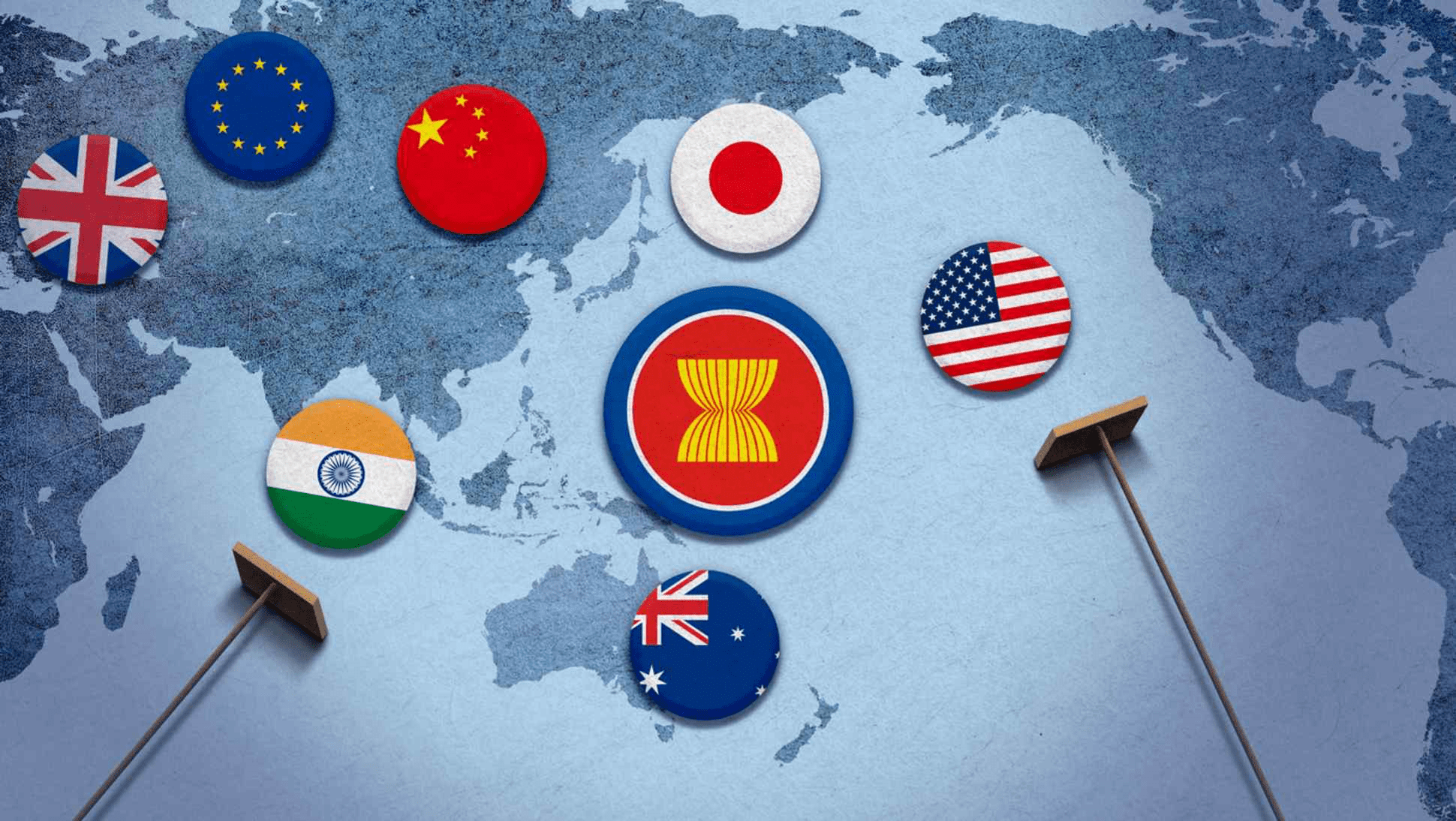
Indo-Pacific has been one of the most spoken buzzwords regionally and globally. Discourses for conceptualizing Indo-Pacific are still in progress. The rift caused by exacerbated US-China rivalry, the Ukraine crisis, and energy and food prices ensued complex enigmas for all stakeholders in the Indo-Pacific region, particularly for ASEAN. This essay, therefore, analyses the embedded meaning of various Indo-Pacific strategies, including the ASEAN Outlook on Indo-Pacific, and suggests how ASEAN should maneuver the strategic reefs in Indo-Pacific.

The Asia’s Geopolitical Circumstances

The US-China tit-for-tat has gotten only worsened since the Ukraine crisis. The US, EU, and its allies have criticized Russia for its horrendous attack and supported Ukraine in an unprecedented manner not only in humanitarian aid but also militarily, albeit the very foundation of the EU, the European Coal and Steel Community, aiming to deter the war under any circumstances.

A mammoth in the room, China has never been quiet per se, but its tone and demand have been stronger over recent years. Xi Jinping even started proposing new initiatives such as Global Development Initiative to regain respect worldwide after overcoming a century of humiliation[1]. From the trajectory of power dynamics, though, it is natural to observe such frictions between existing and emerging ones.

In this inimical dynamic, small and middle countries across Indo-Pacific squirm to avoid being entrapped. Amitav Acharya (2021)[2] defined that “‘Asia’ was built by nationalists, ‘Asia-Pacific’ by economists, ‘East Asia’ by culturalists, whereas ‘Indo-Pacific’ by strategists’”. This definition is succinct yet clear to understand why some countries are in favor or against ‘Indo-Pacific’.

Paradigm Shift

Geographically speaking, China is nestled within the Asia-Pacific region. Since China prioritizes economic development for regional cooperation, such as Belt and Road Initiative, hence tenaciously sticks to Asia-Pacific. On the other hand, as defined by Archarya, Indo-Pacific, encompassing two vast oceans, the maritime strategy is a salient feature. It is worth remembering Wang Gungwu[3] (2019) argued that the maritime domain has been the historians’ and strategists’ core interest for colonial expansion leading to globalization and, furthermore “the focus of global power” (p 129).

Asia-Pacific is arguably obsolete, although China and Russia grapple with holding on to it. Wang (2019) also acutely analyzed that Indo-Pacific would shed more light than ever in the era of paradigm shift[4]. He further argued that ASEAN, therefore, would be given a central role and closely watched by superpowers in the Indo-Pacific domain[5]. Conceptual geographical shifts in parallel with paradigm shifts are being occurred. Therefore, we may need to put howling arguments aside but collect heads to think of paradigm shifts within Indo-Pacific and decode various strategies, outlooks, and frameworks available until today.

ASEAN Outlook on Indo-Pacific

The champion of ASEAN Outlook on Indo-Pacific (AOIP)[6] is undoubtedly Indonesia. As the biggest archipelago in the world, encompassing the Indian and the Pacific Oceans, Indonesia’s ambition to become the global maritime fulcrum is intrinsic. Some naysayers quickly gnaw at the AOIP’s four main areas by belittling those as nothing an inch closer to so-called a strategy. The four main areas, namely maritime cooperation, connectivity, sustainable development and economic cooperation, and other areas, are indeed functional but clearly what ASEAN needs in high demand.

Pragmatists are dissatisfied with the progress of AOIP. They even vilified that incompetence as ASEAN’s chronic disease. The moderate argue that ASEAN threw a dummy in the name of AOIP to collect ideas and tighten its grip, a convening power, to explore, define and develop ideas of Indo-Pacific. Bearing such arguments, Endy Bayuni (2022)[7]calls on superpowers to reconsider Indo-Pacific as a multi-player poker game, not a duel chess game. ASEAN does not wish to judge but remains relevant within and beyond Indo-Pacific to exercise its leeway and leniency for every player, whether big or small, to take part without being neglected.

Earlier this year, Indonesia proposed to mainstream AOIP in all ASEAN-led mechanisms. Still veiled to dialogue partners, this would not be a meticulous manual. Instead, it would suggest a loose guideline allowing maximum flexibility among all parties interested in implementing AOIP with ASEAN on lead. Even though EAS is explicitly mentioned twice as the relevant implementing mechanism in the AOIP, this leaders-led forum does not befit the ASEAN’s initial plan, given the challenging geostrategic circumstances. Alternatively, ASEAN might begin its ‘mainstreaming’ AOIP by incorporating the four main areas in each ASEAN+1 mechanism. In doing so, ASEAN may have multiple options and means to concretize the AOIP. This choice, however, might lead to ambivalence which may turn out as competition among dialogue partners but overlapping and redundancy on the other hand.

Psychological approach

In order to decode ASEAN’s ways of thinking, psychological approaches might be useful. Richard Nisbett wrote an eye-opening book, ‘The Geography of Thoughts[8]‘. Long story short, he argued that Westerners, precisely Europeans, and North Americans tend to think they are in control of their surroundings. They often consider that the rules and laws governed in society are concluded from lengthy discussions and subsidiary decision-making processes. Therefore rules-based and lawful society should not be interfered with or distorted by any supremacy. Asians, on the other hand, think nothing is permanent; hence adaptability to change and environment is crucial rather than sticking to control. Rules and laws are therefore meant to be changed constantly. ASEAN, in this regard, is eager to create a conducive environment where different actors and ideas could be freely floated but not necessarily conflicted. ASEAN would like to be a respected moderator who can exercise adroitness and wisdom to encourage everyone, even dichotomous actors, to try to seek a middle way. Treaty of Amity and Cooperation in Southeast Asia (TAC[9]) is a prime example in which ASEAN has paved the way to consolidate its identity and suggest means under six fundamental principles as a proactive regional group pursuing peace and prosperity. Established in 1976 by five founding member-states, 49 countries[10] are listed as high contracting parties within and beyond the region. TAC suggests six principles that are characterized as highly flexible yet adamant on sovereignty, independence, non-interference, and peaceful settlement. Accession to TAC is a prerequisite for any external parties to tie a knot with ASEAN. Such conditions optimize ASEAN’s leverages to set the agenda for starting businesses in ASEAN Way by maximizing flexibility and inclusivity. Leaving space for maneuvering is ASEAN’s disposition in diplomacy, which is more pronounced in dealing with external partners.

External partners’ contribution to the AOIP

Thus far, Japan, the US, Australia, and the EU, including France, Germany, and the Netherlands, have announced Indo-Pacific strategies. Among ASEAN Dialogue Partners, Japan[11] and India[12] adopted the Leaders’ Statement on pledging to seek concrete cooperation for implementing AOIP.

Dr Shofwan[13] argued that all major powers label strategies or frameworks for their Indo-Pacific concepts while ASEAN retains low-key, using a neutral term, ‘outlook’. Unlike AOIP, major powers’ strategies or initiatives outline values such as freedom, openness, and democracy. These liberal values are embedded in AOIP to some extent but not outspokenly. These values are selective depending on the areas of cooperation or even partners ASEAN wishes to work with. Clearly, options are vast and never limited.

The US allies and partners have published Indo-Pacific initiatives besides the Republic of Korea. The incumbent government has announced a plan to announce its own Indo-Pacific framework underpinning “a pivotal global state, with a focus on promoting freedom, peace, and prosperity based on Seoul’s liberal democratic values[14](Ramon Pacheco Pardo, 2022). Concerns and questions have loomed over the continuity of Korea’s full-fledged support to ASEAN under the New Southern Policy. Nevertheless, ASEAN is considered the centerpiece of its newly unveiled Indo-Pacific framework later this year.

Conclusion

Indo-Pacific is arguably the busiest area where multipolarity would be revealed sporadically. As long as ASEAN remains relevant as a regional group, harsh skepticism over ASEAN’s disunity or being a toothless talk shop would gradually fade away. How ASEAN could safely stay relevant in the Indo-Pacific realm lies in ASEAN’s wisdom. ASEAN needs to be more eclectic to garner various Indo-Pacific strategies and concepts to revisit and detail its very own AOIP step by step. ASEAN never rejected proposals from elsewhere bluntly, and it never will. Conflicting or coalescing into something better is up to ASEAN’s call. For the latter, ASEAN cautiously calculates its psychological strengths and weakness to converge various Indo-Pacific concepts on the ‘middle way’ to encourage ASEAN’s role in the era of paradigm shift.

About Writer:

  • Seonyoung Yang Senior Research Officer at the Mission of the Republic of Korea to ASEAN (2013-Present), MSc of EU Studies and Communication Science from Vrije Universiteit Brussel (2011-12), Graduate Diploma in International Relations from London School of Economics (2016-17), BA of Linguistics from University of East Anglia (2006-9)

Bibliography

  1. The Diplomat (2020, August 20), ‘China’s ‘Never Again’ Mentality,’ Retrieved from https://thediplomat.com/2020/08/chinas-never-again-mentality/
  2. Amitave Acharya (2021, July 8), Retrieved from https://twitter.com/amitavacharya/status/1413139276561145861
  3. Wang Gungwu (2019), ‘China Reconnects: Joining a Deep-rooted Past to a New World Order,’ Singapore: World Scientific, p. 129
  4. Ibid (2019: p. 161)
  5. Ibid (2019: p. 18)
  6. ASEAN Secretariat, ‘ASEAN Outlook on Indo-Pacific’ (2019) Retrieved from https://asean.org/speechandstatement/asean-outlook-on-the-indo-pacific/
  7. Endy Bayuni (2022, July 19) ‘Poker, not chess, is the name of the game in the Indo-Pacific’ available on The Jakarta Post, Retrieved from https://www.thejakartapost.com/paper/2022/07/19/poker-not-chess-is-the-name-of-the-game-in-the-indo-pacific.html
  8. Richard E. Nisbett (2003), ‘The Geography of Thoughts: How Asians and Westerners think differently,’ New York: Free Press
  9. Ministry of Foreign Affairs of Japan (2020, November 12), ‘Joint Statement of the 23rd ASEAN-Japan Summit on Cooperation on ASEAN Outlook on the Indo-Pacific,’ Retrieved from https://www.mofa.go.jp/files/100114942.pdf
  10. ASEAN Secretariat (2022, August 16), ‘Treaty of Amity and Cooperation in Southeast Asia (TAC),’ Retrieved fromhttps://asean.org/our-communities/asean-political-security-community/outward-looking-community/treaty-of-amity-and-cooperation-in-southeast-asia-tac/#:~:text=The%20Treaty%20of%20Amity%20and,in%20the%20region%20and%20beyond
  11. ASEAN Secretariat (2021, October 28), ‘ASEAN-India Joint Statement on Cooperation on the ASEAN Outlook on the Indo-Pacific for Peace, Stability, and Prosperity in the Region,’ Retrieved from https://asean.org/asean-india-joint-statement-on-cooperation-on-the-asean-outlook-on-the-indo-pacific-for-peace-stability-and-prosperity-in-the-region/
  12. Habibie Center Youtube (2022, July 6), ‘Talking ASEAN on “The US’ New Indo-Pacific Strategy and the Future of Taiwan’s Strait Stability,’ Retrieved from https://www.youtube.com/watch?v=PNXuEeJ66Rs
  13. Ramon Pacheco Pardo (2022) ‘South Korea as a global pivotal state: the role of partners’ https://brussels-school.be/publications/policy-briefs/south-korea-%E2%80%9Cglobal-pivotal-state%E2%80%9D-role-partners Brussels: CSDS Policy Brief 07/2022

ASC Commentaries | Cross-Border Digital Payment Integration: What Will We Achieve?

[av_heading heading=’ASC Commentaries | Cross Border Digital Payment Integration: What Will We Achieve?’ tag=’h3′ style=” subheading_active=” show_icon=” icon=’ue800′ font=’entypo-fontello’ size=” av-medium-font-size-title=” av-small-font-size-title=” av-mini-font-size-title=” subheading_size=” av-medium-font-size=” av-small-font-size=” av-mini-font-size=” icon_size=” av-medium-font-size-1=” av-small-font-size-1=” av-mini-font-size-1=” color=” custom_font=” subheading_color=” seperator_color=” icon_color=” margin=” margin_sync=’true’ padding=’10’ icon_padding=’10’ headline_padding=” headline_padding_sync=’true’ link=” link_target=” id=” custom_class=” template_class=” av_uid=’av-l6kk83sa’ sc_version=’1.0′ admin_preview_bg=”][/av_heading]

[av_slideshow size=’no scaling’ control_layout=’av-control-default’ conditional_play=” animation=’fade’ transition_speed=” autoplay=’false’ interval=’5′ img_scrset=” lazy_loading=’enabled’ alb_description=” id=” custom_class=” template_class=” av_uid=’av-l6kklhaj’ sc_version=’1.0′]
[av_slide slide_type=’image’ id=’6060′ video=’https://’ mobile_image=” fallback_link=’https://’ title=” video_ratio=’16:9′ custom_title_size=” av-medium-font-size-title=” av-small-font-size-title=” av-mini-font-size-title=” custom_size=” av-medium-font-size=” av-small-font-size=” av-mini-font-size=” font_color=” custom_title=” custom_content=” heading_tag=” heading_class=” link_apply=” link=’lightbox’ link_target=” av_uid=’av-l6kky2f6′ sc_version=’1.0′][/av_slide]
[av_slide slide_type=’image’ id=’6053′ video=’https://’ mobile_image=” fallback_link=’https://’ title=” video_ratio=’16:9′ custom_title_size=” av-medium-font-size-title=” av-small-font-size-title=” av-mini-font-size-title=” custom_size=” av-medium-font-size=” av-small-font-size=” av-mini-font-size=” font_color=” custom_title=” custom_content=” heading_tag=” heading_class=” link_apply=” link=’lightbox’ link_target=” av_uid=’av-l6kkkrsq’ sc_version=’1.0′ video_autoplay=” video_controls=” video_mute=” video_loop=”][/av_slide]
[av_slide id=’6054′ slide_type=” video=’https://’ mobile_image=” fallback_link=’https://’ title=” video_ratio=’16:9′ video_autoplay=” video_controls=” video_mute=” video_loop=” custom_title_size=” av-medium-font-size-title=” av-small-font-size-title=” av-mini-font-size-title=” custom_size=” av-medium-font-size=” av-small-font-size=” av-mini-font-size=” font_color=” custom_title=” custom_content=” heading_tag=” heading_class=” link_apply=” link=” link_target=” av_uid=’av-21iiq1′ sc_version=’1.0′][/av_slide]
[/av_slideshow]

An Online Citizen: Revealing Restrictions on the Freedom of Press and Mass Media in Singapore

Written by: Syukron Subkhi

Democracy is continually evolving to keep pace with the changing nature of the world. In the digital era, a new form of democracy has emerged through the transformation of media or other tools used to implement the principles of democracy, such as digitalization. Digital democracy is tied to modernization in a variety of daily life aspects. Accordingly, the internet provides a more open platform to access opinion and expression worldwide rather than traditional mass media.

There is a role for the media and press in overseeing the formation of various government policies and regulations. Media criticism is thought to be more effective in empowering the community to shape policies centered on citizens’ interests. So far, it appears that independent media and press are generating critical voices to influence public opinion against the government. The goal is to ensure and control that the government policies and activities are in accordance with applicable law (Lestaluhu, 2015).

Current Situation on Democracy and Press Freedom in Singapore

One way to exercise one’s democratic right to free speech is through the press and other forms of mass media. According to the 2021 Democracy Index, the indicator of civil liberties -comprises individuals’ fundamental rights and liberties that are protected against any arbitrary measures or other government intervention without due process of law- in Singapore is at the point of 6.18 out of 10, and the country’s average score with four other indicators is 6.23, despite Singapore’s relatively high economic level compared to other ASEAN member countries (Arbar, 2022). In terms of press freedom, Singapore is ranked 141st out of 200 countries on UDI and 66th overall based on an average of the other four indicators. This places Singapore as one of the countries with a faulty democracy system. (EIU, Democracy Index 2021: The China Challenge, 2022).

The Singapore Parliament passed the Foreign Interference Act (FICA) on October 4, 2021. People’s freedom of movement and political participation are at risk under this law, which could be used as ambiguous yet biased laws to weaken the “people power” and ability to influence the ruling government. According to the International Court of Justice, FICA violated international human rights law’s principles of legality, necessity, and proportionality. Unnecessarily sweeping legislation covers a wide range of politically-motivated conduct in Singapore. The FICA Law’s unclear provisions also give the executive branch the ability to interpret and implement the law in any way they see fit (ICJ, 2021).

One of the most damaging aspects of FICA is its ability to allow the executive, through Singapore’s Ministry of Home Affairs (MHA), to order the removal or deactivation of online content. The provisions of the FICA Act state:

“Activities carried out in connection with foreign interests and directed at political ends in Singapore may be criminalized if there are indications of communications being conducted in secret or with fraud, including the intentional use of encrypted communication platforms.”

There is a wide range of activities that fall under the umbrella of “activities aimed at political ends,” including social justice advocacy, artistic commentary, academic research, and journalistic coverage by members of the public and private sectors. Singaporeans’ ability to organize and participate in public affairs will be severely restricted by this law, it is clear (ICJ, 2021). This issue will definitely affect the versatility of the democratic advocacy activities, for instance, The Online Citizen that will be discussed in this article.

The International Court of Justice (ICJ) believes that punishments for violators of FICA laws are disproportionate and that many of these sentences can be imposed without adequate independent oversight or remedies in cases of human rights violations, which can have long-term negative effects on public discourse. Authorities may fine censored online content, accounts, services, apps, and locations (ICJ, 2021). As a result, UDI Singapore’s political participation and political culture assessment indicators have been lowered from 4.44 and 7.50 to 4.44 and 7.50, respectively. (EIU, Democracy Index 2021: The China Challenge, 2022).

“An Online Citizen”

In order to express and criticize the government’s abuse of power, a documentary film titled “an Online Citizen” was made, which examines how the government of Singapore controls nearly 90% of the country’s media and the information that is widely available there. “An Online Citizen” was produced in 2019 and directed by independent British journalist Calum Stuart, who lives in Singapore. This documentary film features the story of Terry Xu, the Chief Editor of TOC (The Online Citizen), a platform for blogging communities in Singapore. He describes this film as “very observational” to investigate the expression of democracy in Singapore is slightly restrained (in an interview with the New York Times).

Scene from the film “an Online Citizen”

In order to better understand the impact of the film’s production, the film’s director was given permission to focus on examining the effects that were experienced by groups of people or organizations, independent journalists, and media outlets towards the implementation of POFMA (The Protection from Online Falsehoods and Manipulation Act). As a result of the passage of POFMA by the Singaporean Parliament, the political and democratic situation in Singapore has become tenser and more charged than it had been previously. TOC is an excellent choice for the primary subject of a documentary because of the fact that the TOC is a long-standing media community in Singapore that has been active and steadfast in conveying personal freedom and conveying information in Singapore.

“an Online Citizen” managed to accomplish two things at once. The movie demonstrates that TOC, as an independent media community, has limitations in conveying criticism and facts about poor policy-making in Singapore from the perspective of public involvement, as well as the criminalization of journalists and media that are against the government. First and foremost, the Singapore Broadcasting Law’s blocking of this movie shows the government’s unwillingness to accept criticism and opinions from the public because it is feared that it will lead to an increase in public awareness of direct political participation, which could influence policy-making. These facts demonstrate how the current Singaporean government restricts and harms the freedom to express one’s views and take part in politics, both of which are essential components of a healthy democracy.

Conclusion and Recommendation

The rights of freedom of expression and participation in political movement are part of the fundamental aspects of democracy which are stated in Article 19 of the Universal Declaration of Human Rights 1948. As a country that adopted the democratic system for its governance, it is mandatory for Singaporean Government to protect its people to actively participate in political movements. Disobeying the human rights mechanism means that the ruling government fails to implement the commitment to the democratic system.

This issue needs a deep concern and understanding, where the legal systems will be unable to protect the critical voices of its people from the ruling government that has the power in controlling the media and surpass ambiguous laws without truly independent courts. Attempting to embarrass the government’s action is arguably an effective and potent measure of those who favor freedom of expression. Bringing to light instances of legal actions, persecutions, and violations against journalists and their publications in the form of critical and creative approaches may seem modest, but it might mean the difference between freedom and its antithesis.

About Writer

  • Syukron Subkhi is a Media Publication and Research Assistant at ASEAN Studies Center Universitas Gadjah Mada. He holds a bachelor’s degree in social sciences majoring in International Relations with a particular focus on human rights, democracy, and development studies. He can be contacted through syukron.subkhi@ugm.ac.id

Bibliography

  1. Lestaluhu, S. (2015, April 2). Peran Media Massa dalam Mengawal Kebijakan Publik di Ambon. p. 2.
  2. EIU. (2022). Democracy Index 2021: The China Challenge. London: The Economic Intelligence Unit.
  3. Arbar, T. F. (2022, February 11). Daftar Terbaru Negara Terkaya Asia Tenggara, RI Nomor Berapa? . Retrieved from CNBC Indonesia: https://www.cnbcindonesia.com/news/20220211090408-4-314601/daftar-terbaru-negara- terkaya-asia-tenggara-ri-nomor-berapa
  4. ICJ. (2021). Singapore: Withdraw Foreign Interference (Countermeasures) Bill. International Court of Justice.


ASEAN Para Games 2022: From Sports to Cultural Diplomacy

Written by: Ferdian Ahya Al Putra

Indonesia should be proud after successfully organizing the Asian Games and Asian Para Games in 2018. Now Indonesia is assigned to host the ASEAN Para Games 2022. ASEAN Para Games is the largest disability sports party or event in Southeast Asia (Kemenko PMK, 2022). This time, the ASEAN Para Games will be held on 30 July – 6 August 2022 in Central Java Province, including Solo City, Semarang City, Sukoharjo, and Karanganyar (Kemenpora, 2022).

Inside the ASEAN’s structure, they have ASEAN Ministerial Meeting on Sport (AMMS). To support AMMS, ASEAN organized the Senior Officials Meeting on Sports (SOMS). In short, they agreed to assist AMMS in enhancing cooperation in sports or related activities towards balanced sports development in ASEAN; Promoting a healthier lifestyle among citizens of ASEAN Member States through sports, encouraging more interaction among peoples of ASEAN, thus fostering friendship among the ASEAN  Member  States,  as well as contributing to ASEAN integration and community building; Advocating and promoting the role of sports in regional development, peace and stability; and Promoting sportsmanship,  competitiveness and an ASEAN  culture of excellence in sports at the regional and international levels (ASEAN, 2011). This ASEAN Para Games could be one of the programs they organized to achieve the objectives.

Sports Diplomacy Concept

 The ASEAN Para Games can be used as momentum in introducing culture and tourism, especially in Solo or the cities around. This goal is closely related to the term sports diplomacy. In a review published by the European Union, it is understood that Sports Diplomacy is an aspect of public diplomacy, and it can be used as a soft-power tool for an increasing number of purposes (Murray & Prince, 2020). Murray also defined “Sports Diplomacy” as a new term that describes an old practice: the unique power of sport to bring people, nations, and communities closer together via a shared love of physical pursuits (Murray, 2020).

Based on this concept, it can be understood that sport can be a tool to achieve diplomatic goals. The 2022 ASEAN Para Games is an excellent opportunity to attract tourists, especially when Solo is the location for the event. As in Yogyakarta or Bali, both have strong cultural elements which are a big attraction for foreign tourists. Meanwhile, Solo is also a city with cultural tourism. In other words, this event is the right opportunity to introduce Solo to the international scene especially tourists who have come to watch the ASEAN Para Games. The packaging of the ASEAN Para Games this time also cannot be separated from the cultural elements attached to Solo. For example, the 2022 ASEAN Para Games logo also includes cultural elements, namely the illustration of ‘gulungan’ as part of the wayang, a Javanese puppet symbol. A dagger in the logo’s center further emphasizes the event’s cultural element. In addition to the logo, the committee also presented the Rajamala Mascot, which Rojomolo read according to the Javanese accent. Rajamala is known to be unrivaled and is symbolized as the power to resist evil or a negative aura. Rajamala is also a palace heirloom in the form of a can think that symbolizes the greatness of the Surakarta Palace (Jawapos, 2022). This shows that the committee is trying to push cultural diplomacy through sports.

Logo and Mascot of 11th ASEAN Para Games (Foto: Jawapos)

Culture, Tourism, and Culinary in Solo

Talking about culture and tourism, Solo has various cultural sites worth visiting by both local and foreign tourists. In Solo, there are two symbols of royal history: Kasunanan Palace and Mangkunegaran Palace. The Giyanti Agreement signed in 1755 divided the Sultanate of Mataram into two powers, namely the Surakarta Sunanate and the Yogyakarta Sultanate (Darmawan, 2017). While the Mangkunegaran Palace is the place where the kings or dukes of Mangkunegaran reside. This palace was built by Raden Mas Said or Prince Sambernyawa, the founder of Mangkunegaran who holds the title Kanjeng Gusti Pangeran Adipati Arya (KGPAA) Mangkunegara I (Ningsih, 2021). In addition, tourists can visit other cultural sites as alternatives, such as the Heritage Batik Keris, the Press Monument, the Nusantara Keris Museum, and so on.

Furthermore, Solo has Batik industrial centers, especially in two Batik villages in the Laweyan and Kauman areas. As we all know, Batik is a world heritage site in Indonesia. The recognition of batik as a world heritage has been in effect since the United Nations Educational, Scientific and Cultural Organization (UNESCO) established Batik as Masterpieces of the Oral and the Intangible Heritage of Humanity on 2 October 2009 (KWRI UNESCO, 2017). In addition to culture, Solo has various distinctive culinary delights with a high taste. The local culinary potential includes Nasi Liwet, Soto, Gudeg, Selat, Pecel, Timlo, Bestik, Tengkleng, and so on. Saeroji and Wijaya (2017) mention that Solo has great culinary potential. They mentioned, for example, that in the Banjarsari sub-district, there are 12 culinary destinations, in Serengan 7 culinary destinations, in Jebres 7 culinary destinations, six culinary destinations in Laweyan, and three destinations in the Kliwon market area. Therefore, visiting Solo is a good opportunity to get to know or buy Batik directly from the industrial center and become a unique attraction for tourists to taste its exceptional cuisine.

Festival in Solo: Solo Batik Carnival (Foto: Instagram/ solobatikcarnival_official)

In other words, this time, the ASEAN Para Games can be an opportunity to introduce Solo’s culture and tourism. Sports expert at Universitas Sebelas Maret (UNS), Febriani Fajar Ekawati, M.Or., Ph.D., mentioned that the event has the potential to revive Solo’s economy. The two main sectors that will be affected by the implementation of the 2022 ASEAN Para Games are the industry and tourism sectors. She also mentioned that the benefits of the ASEAN Para Games for the tourism sector could occur in 2 types, tangible and intangible. The tangible benefit refers to the hotel sector that had fallen due to the pandemic, which will be booked for ASEAN Para Games athletes, coaches, and officials. The hotel is full of guests, and the shops around the hotel can also sell daily necessities and souvenirs. The guests will undoubtedly ogle the culinary sector.

Meanwhile, intangible in nature, namely the icon of Solo, will be worldwide. Several international media will report interesting things about Solo so that this city will be known to the broader world community (UNS Public Relations, 2022). This view is also supported by Solo’s mayor, Gibran Rakabuming, who stated that he wants Solo, a small city with a solid cultural background. The world can see how successful it is in organizing sporting events such as the Asean Para Games (Herdyanto, 2022). In addition, Solo is known as a ‘festival city’ where they already host various cultural festivals such as Solo Batik Carnival, Solo International Performing Arts, Festival Jenang (Traditional cuisine display), etc. This will also enhance the attractiveness of Solo itself.

Based on the concept above, the ASEAN Para Games can help the government to introduce Solo and its tourism to the international view. Relevant parties, from the government to the committee, it is essential to pay attention to the elements contained in the implementation, such as by displaying cultural elements in it or serving special cuisines from Solo for consumption for athletes, officials, journalists, and spectators. It is also important to distribute information about tourism and culinary in Solo along with access if a tourist wants to move from one place to another, for example, through information boards, social media or other digital platforms. This aims to reach the ASEAN pillar, namely the economic pillar, where one of the points to be encouraged is to optimize the tourism sector.

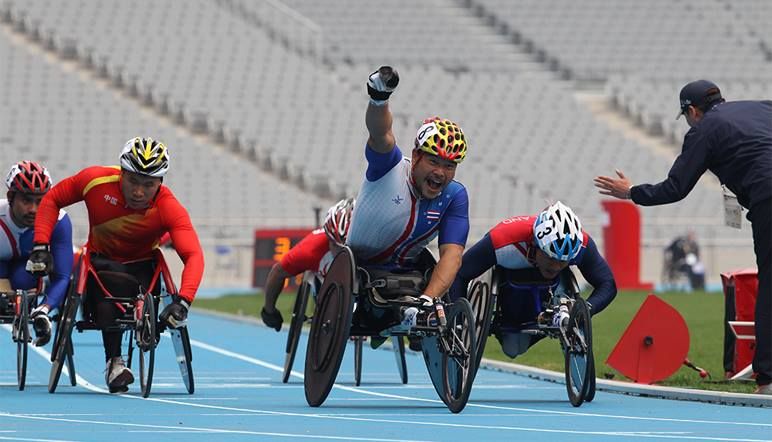
ASEAN Para Games, in this case, is not just a sports party. In a more social realm, this can be an opportunity to strengthen solidarity between ASEAN countries by upholding sportsmanship when competing. This is appropriate with Murray’s argument that sport can bring people and nations closer through sports competition. This is also a place to show off athletes with disabilities. This also emphasizes that sport can be inclusive, which means that everyone has the same opportunity to compete where the motto of this event is “Striving for Equality”. In this context, sport influences the relation among ASEAN members as the concept of sports diplomacy is mentioned. The most crucial point is upholding sportsmanship and fair play value at first, then it will be followed by how sport can strengthen engagement among the member countries of ASEAN.


About Writer

  • Ferdian Ahya Al Putra is a Programme Intern at ASEAN Studies Center, Universitas Gadjah Mada. He finished his bachelor’s degree at the International Relations Department, Universitas Sebelas Maret, and his master’s degree at International Relations Department, Universitas Gadjah Mada. He is also an LPDP Scholarship Awardee from the Ministry of Finance, Republic of Indonesia. He can be contacted through email: ferdian.ahya.al@mail.ugm.ac.id or ferdianahya@gmail.com

Bibliography

  1. ASEAN. (2011). 4. Advocating and promoting the role of sports in regional development, peace and stability;;. ASEAN. Retrieved July 19, 2022, from http://asean.org/wp-content/uploads/2018/02/TOR-of-SOMS.pdf
  2. Darmawan, J. (2017). Mengenal Budaya Nasional “Trah Raja-raja Mataram di Tanah Jawa”. Deepublish. https://books.google.co.id/books/about/Mengenal_Budaya_Nasional_Trah_Raja_raja.html?id=Xm85DwAAQBAJ&redir_esc=y
  3. Herdyanto, H. (2022, June 21). Wali Kota Solo Inginkan Asean Para Games 2022 Jadi Ajang Untuk Mendongkrak Budaya Solo di Pentas Dunia – Mitra News. Mitranews.net. Retrieved July 18, 2022, from https://www.mitranews.net/hot-news/pr-1053717389/wali-kota-solo-inginkan-asean-para-games-2022-jadi-ajang-untuk-mendongkrak-budaya-solo-di-pentas-dunia
  4. Humas UNS. (2022, February 9). Pakar Olahraga UNS Sebut ASEAN Para Games 2022 Berpotensi Bangkitkan Industri dan Pariwisata Solo. Universitas Sebelas Maret. Retrieved July 15, 2022, from https://uns.ac.id/id/uns-update/pakar-olahraga-uns-sebut-asean-para-games-2022-berpotensi-bangkitkan-industri-dan-pariwisata-solo.html
  5. Jawapos. (2022, June 10). Logo dan Maskot ASEAN Para Games 2022 Diluncurkan. Radar Solo. Retrieved July 19, 2022, from https://radarsolo.jawapos.com/sport/sport-nasional/10/06/2022/logo-dan-maskot-asean-para-games-2022-diluncurkan/
  6. Kemenko PMK. (2022, March 9). Indonesia Mantapkan Persiapan ASEAN Para Games 2022 | Kementerian Koordinator Bidang Pembangunan Manusia dan Kebudayaan. Kemenko PMK. Retrieved July 11, 2022, from https://www.kemenkopmk.go.id/indonesia-mantapkan-persiapan-asean-para-games-2022
  7. Kemenpora. (2022, July 6). 11th ASEAN Para Games 2022 Mengundang Putra-Putri Bangsa untuk Berkontribusi dan Mengasah Talenta melalui Program Volunteer. Kementerian Pemuda dan Olahraga. Retrieved July 11, 2022, from https://www.kemenpora.go.id/event/10/11th-asean-para-games-2022-mengundang-putra-putri-bangsa-untuk-berkontribusi-dan-mengasah-talenta-melalui-program-volunteer
  8. KWRI UNESCO. (2017, October 2). Hari Ini 8 Tahun Lalu, UNESCO Akui Batik sebagai Warisan Dunia Asal Indonesia. KWRI UNESCO. Retrieved July 15, 2022, from https://kwriu.kemdikbud.go.id/berita/hari-ini-8-tahun-lalu-unesco-akui-batik-sebagai-warisan-dunia-asal-indonesia/
  9. Murray, S. (2020, 27 October). Sports Diplomacy: History, Theory, and Practice. oxfordre.com. Retrieved July 2022, 19, from https://oxfordre.com/internationalstudies/view/10.1093/acrefore/9780190846626.001.0001/acrefore-9780190846626-e-542.
  10. Murray, S., & Prince, G. (2020, October 27). SPORT DIPLOMACY:. IRIS – Institut de Relations Internationales et Stratégiques. Retrieved July 12, 2022, from https://www.iris-france.org/wp-content/uploads/2021/09/1-TES-D_LiteraryReview-of-a-scholarly-and-policy-recources.pdf
  11. Ningsih, W. L. (2021, October 10). Beda Keraton Surakarta dan Mangkunegaran Halaman all. Kompas.com. Retrieved July 15, 2022, from https://www.kompas.com/stori/read/2021/10/10/120000179/beda-keraton-surakarta-dan-mangkunegaran?page=all
  12. Padhi, S. D. S. A. a. F. 2. B. (2011, 1 January). Sports Diplomacy: South Africa and FIFA 2010. Insight of Africa, 3(1), 55-70. https://doi.org/10.1177%2F0975087814411132