
Top 3 Policy Briefs
- First Place – “Collaborating Youth Power for Child and Women Protection from Online Gambling Risks in ASEAN Countries”, by Muh. Rifki Ramadhan, Bagas Febi Cahyono, and Muhammad Rifki Nur Aprialdi.
- Second Place – “Towards a Resilient Marawi: Policy Recommendations for Inclusive Recovery and Sustainable Development Post the 2017 Marawi Crisis”, by Christopher Paller Gerale.
- Third Place – “Empowering ASEAN Youth Through Ministri(es) Initiatives Amid Myanmar’s Crisis: A Path to Humanitarian and Policy Engagement”, by Muwalliha Syahdani, Herbagus Unggul, and Thant Thura Zan.

Top 10 Selected Policy Briefs
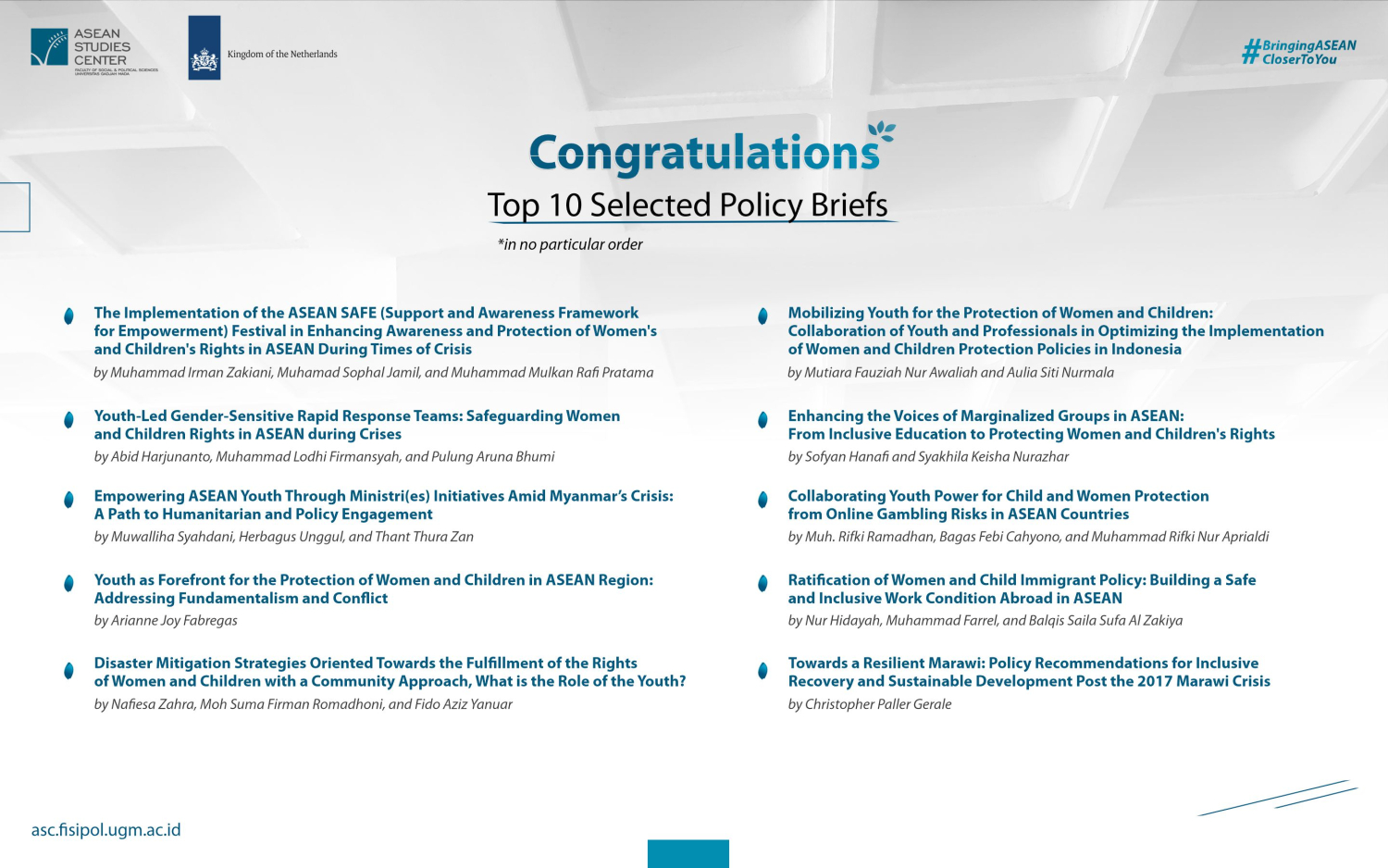
The wait is over; congratulations to the top 10 selected policy briefs. Meanwhile, the top three winners will be announced in due course. And to all participants who have submitted policy briefs and ideas, thank you for your enthusiasm.
Stay tuned on ASC social media for more information. #BringingASEANCloserToYou

Background
Despite progress made in recent years, women and children continue to face various forms of discrimination, violence, and inequalities across ASEAN member states. The current state of the world has become less safe and increasingly dangerous. Developments in Ukraine, the Palestinians, and within ASEAN member states itself, such as in Myanmar, tell us that the prolonged conflicts, wars, and violence have directly affected women and children as the most fragile members of the community. Promoting safe and empowered women and children is multifaceted and presses on the world’s growing concern, not excluding ASEAN. At its core, the issue stems from systemic gender disparities and vulnerabilities that persist in ASEAN countries, including limited access to education, healthcare, economic opportunities, and legal protections. Women and children often bear the brunt of poverty, lack of resources, and cultural norms that perpetuate gender-based violence and discrimination. Hence, when conflict and natural disasters are added into the equation, it poses greater challenges to their safety and well-being, including child trafficking and displacement of women and children from their families.
In shaping the future of ASEAN beyond 2025, the ACWC has a crucial role to be at the forefront in driving closer regional cooperation among relevant ASEAN Sectoral Bodies in promoting and protecting the rights of women and children, especially the disadvantaged, those living in vulnerable situations as well as, using rights and gender perspectives. Some notable developments have been made. The ACWC will institutionalize gender mainstreaming efforts across the ASEAN Community pillars through the ASEAN Gender Mainstreaming Steering Committee (AGMSC), together with the ASEAN Committee on Women (ACW). They reaffirmed their commitment to utilize a whole-of-ASEAN approach in implementing the ASEAN Gender Mainstreaming Strategic Framework (AGMSF). They further supported Indonesia on the roll-out of the ASEAN Do-No-Harm Guide for Frontline Responders: Safeguarding the Rights of Victims of Trafficking in Persons – launched on 11 January 2023 with support from the ASEAN-ACT.
The ACWC has also committed to continue to implement the ASEAN Regional Plan of Action on Women, Peace and Security (ASEAN RPA on WPS) with stronger advocacy and capacity-building efforts, especially in the security sector as well as ASEAN Regional Plan of Action on Ending Violence against Women (ASEAN RPA on EVAW). However, there remains a looming gap between the progressive realm of policy-making at a regional level and its implementation at home. CSOs play a crucial role in advocating for the rights of women and children, providing essential services, and holding governments accountable for their commitments. Similarly, academia contributes through research, analysis, and evidence-based recommendations to inform policy development and program interventions. However, a tri-party collaboration remains seldom despite it being much needed. This seminar is held to map the many ways that ACWC, CSOs, and academia can become the strong arm for the promotion and protection of women and children in ASEAN as well as internationally.
Guiding Questions
- What are the effective strategies for raising community awareness regarding the importance of safeguarding the rights and well-being of women and children?
- What steps can be taken by the youths to empower and promote the protection of women and children in ASEAN in times of crisis?
General Terms and Conditions
- The participant is an active university student. A student identification card or other supporting document is needed to prove active status.
- Participants can be an individual or a group consisting of a maximum of 3 persons.
- Participants are encouraged and expected to read the entirety of the guidelines provided in ASC website.
List of Prizes:
- Grand Prize (1st Place) IDR 3,000,000
- Excellence Prize (2nd Place) IDR 2,000,000
- Merit Prize (3rd Place) IDR 1,000,000
- E-Certificate for Top 10 Selected
Policy Brief Guidelines
- The policy brief must be original work and has not been published in the other publication platforms.
- The policy brief must capture the role of youth in promoting and protecting the rights of women and children in ASEAN issues. You may use the theory, framework, and approach that you have learned.
- Use American English for your writing.
- Font: Times New Roman, font size: 12, line spacing: 1.25, spacing before: 0 pt, spacing after: 12 pt.
- Full policy brief length: 1,200 – 1,500 words. Excluding footnotes and references.
- The author notes that the policy brief can not be withdrawn at any condition once it is accepted by the committee.
- The policy brief must follow these structures to ensure clarity and effectiveness in communicating key points:
- Title
A clear and concise title that reflects the topic of the brief. Write your name below the title. - Executive Summary
A brief overview of the policy issue, the key findings, and the main recommendations. It should provide a snapshot of the entire brief. - Introduction
Explain its significance and relevance. Provide the necessary background information to help the reader understand the issue better. This section should include relevant statistics, historical context, and policy history. - Problem Statement
Clearly articulate the problem or issue that the policy brief is addressing. This should be specific, concise, and backed up by evidence. - Policy Analysis
This section explains the reasoning behind your policy recommendations. In effect, this section describes the problem that your policy recommendations intend to solve. It should include an analysis of current policies related to the issue, their strengths, weaknesses, and any gaps or areas that require improvement. - Policy Recommendation
Present your proposed solutions or recommendations. These should be clear, specific, and actionable. Explain how these recommendations address the identified problem and why they are the best course of action. It’s essential to provide evidence and examples to support your recommendations. - Conclusion
This final section of the policy brief should detail the actions recommended by your findings. Summarize the key points of the policy brief, emphasizing the importance of the recommendations and their potential impact on the issue. - References
Include a list of all the sources and references used in the brief. Follow a consistent APA citation style.
8. Incorporate visuals into the policy brief. Choose effective visuals for the type of information you would like to communicate. For example, pie charts and bar graphs are preferable to data tables to illustrate findings. Include captions for photos and other visuals that explain the content to the reader.
9. The policy brief will be curated and published by the ASEAN Studies Center for academic purposes.
Submission and Competition Technicalities
Submission is to be submitted through ugm.id/ASCPBC24
- File naming should be Last name_Policy Brief [E.g. Saputra_Policy Brief (individual) or Saputra, Firhansyah & Ashari_Policy Brief (groups).
- The submitted policy brief should be in PDF format.
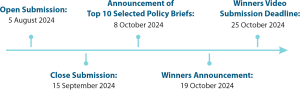
- The latest submission to be made is by Sunday, the 15th of September.
- One representative is sufficient for group submission to submit the final policy brief.
2. Ten of the best policy briefs will be selected to continue to the next stage. This will be announced 8th of October.
3. The top three winners will be announced on the 19th of October 2024
4. The winners are asked to make a 10 minutes video presenting their policy brief.
Submit Your Policy Brief here: ugm.id/ASCPBC24
Timeline
Contact Person
Mr. Tunggul Wicaksono
Research Manager, ASEAN Studies Center Universitas Gadjah Mada