Press Release: Working Conference – ASEAN-UK Relations in the Changing Regional Architecture

A Working Conference under the theme of “ASEAN-United Kingdom Relations in the Changing Regional Architecture” was held on 18-19 February 2020. It brought together experts from ASEAN Member States and Southeast Asian experts from the United Kingdom to exchange ideas on creating strategic partnership avenues between ASEAN and the United Kingdom with acknowledgement towards the rapidly changing regional architecture. The Conference was held at the recently inaugurated building of the ASEAN Secretariat, Jalan Sisingamangaraja, Jakarta, Indonesia. The two-day event covered presentations and discussions on various topics and was concluded by a site trip around the new and Heritage buildings of the ASEAN Secretariat. The panelists consisted of researchers from the ASEAN Member States, with the exception of representatives from Myanmar and the Philippines who were unable to attend, and the United Kingdom. The Ambassador of the United Kingdom to ASEAN, Deputy Secretary-General of Community and Corporate Affairs, and ASEAN entities also attended the event.

Prior to the Working Conference, a welcoming dinner was hosted on Monday, 17 February 2020, at the 1O1 Hotel Darmawangsa, at 19.00. The following day, Tuesday, 18 February 2020, participants arrived at 08.30 to register before the Conference commenced at 09.00. The Working Conference was officiated with opening remarks from the Executive Director of the ASEAN Studies Center, Universitas Gadjah Mada, Ambassador of the United Kingdom to ASEAN, and the Deputy Secretary-General of ASEAN for Community & Corporate Affairs. The opening was followed by a photo session.

The first session took place after a brief coffee break. Discussions took place under the theme, “ASEAN in the Changing Geostrategic Theatre”. The presenting panelists were from Indonesia, Brunei Darussalam, and United Kingdom. The discussion evolved around the institutional agility and internal cohesion of ASEAN’s Centrality, historical references of ASEAN and its present, and further extended to discuss Brexit, Britain, and the World. The first session was concluded with a Question & Answer session.

The second session reconvened after a brief coffee break, at 11.00. The discussions evolved around “ASEAN External Relations” highlighting proposed narratives of researchers from the United Kingdom and Singapore. The session looked into the impacts of Britain’s historical role in the Southeast Asian region, Brexit, United Kingdom’s engagement to ASEAN, and response to the changing regional politics. This session also delved into talks of the ways forward for both ASEAN and the United Kingdom post-Brexit. It proposed focusing on engaging the ASEAN Chairmanship, in effort of establishing a meaningful tie with the region. The session was also followed by a Question & Answer session, and a lunch break.

The third session highlghted the role that the ASEAN entities play in strengthening the ASEAN Communities. The theme of the discussion was an “Introductory Presentation by ASEAN Secretariat and Associated Entities” which brought the views of the ASEAN Secretariat, ASEAN Institute of Peace and Reconciliation (AIPR), ASEAN Foundation, and ASEAN Inter-Parliamentary Assembly (AIPA). This session looked into the functions of the Secretariat, how Community building in the region is promoted through peace, stability, and understanding, as well as through the strengthening of the role of the youth.

Due to time constraint, the fourth session was held in conjunction with the fifth. The fourth session highlighted the views of researchers from Thailand, Cambodia, United Kingdom, on “ASEAN and Its People-Centeredness: Still Relevant?”. Participants looked at the challanges and ways forward of the people-centered ASEAN, questioned what bring people-centered and people-oriented means for the community-building effort of ASEAN, how the digital ambition of ASEAN looks like and what opportunities this leaves for the United Kingdom. Further, the panelists also looked into how the people-centered and people-oriented goal of ASEAN would play into the rapidly evolving regional security architecture. This lead to the fifth session under the theme of “ASEAN Regionalism”. Panelists from Vietnam, Malaysia and Lao PDR looked at sectors which provided greater opportunities for a stronger colaboration, namely in education, trade, and security. The Q&A for the fourth and fifth sessions were accommodated in conjuction. All five sessions of the Working Conference were moderated by the ASEAN Studies Centre. The Conference ended at 17.45 afterwhich the participants returned to 101 Hotel Darmawangsa.

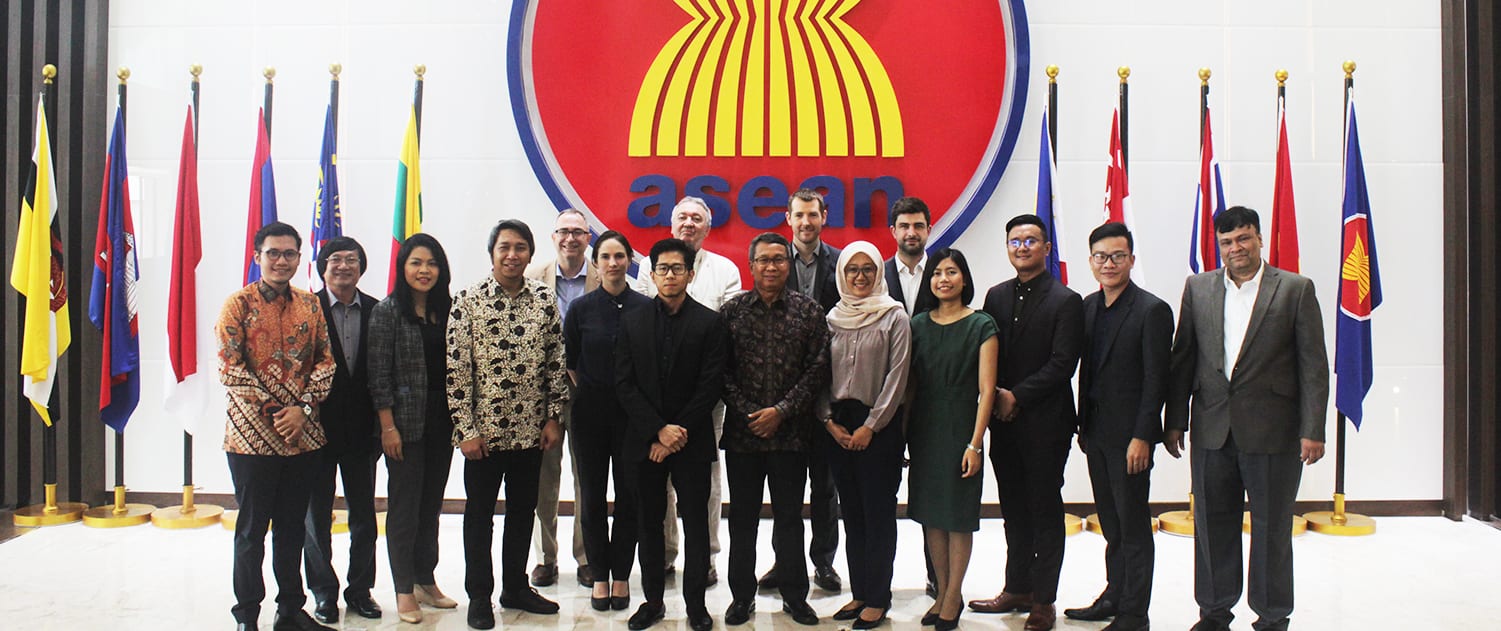
Registration for the second day opened at 09.30 at the Video Conference Room, North Tower, ASEAN Secretariat. The session commenced at 10.00 to wrap-up the discussion from the previous day. Participants brainstormed possible outputs of the Working Conference, agreed on solidifying the Network of ASEAN-UK Think Tanks (NAUT) and looked into the possibilities of mainstreaming ASEAN studies in the UK. The discussion was held for two hours and was followed by a photo session. Participants were directed to the Lobby of the ASEAN Secretariat to have a photo session in front of ASEAN emblem, before enjoying the provided lunch. After lunch, participants were facilitated a site visit of public spaces within the new and Heritage ASEAN Secretariat building, by the ASEAN Secretariat. Participants visited the sky bridge connecting the North and South towers of the Secretariat, the Art Gallery, the Nusantara Hall, Library, the recently renovated Gift Shop, and the ASEAN Hall within the premise of the ASEAN Heritage Building. The visit to the ASEAN Heritage Building marked the end of the last day of “Working Conference on ASEAN-UK Relations in the Changing Regional Architecture”.

Internship at ASEAN Studies Center 2021

Greetings from the ASEAN Studies Center UGM!

This year,  ASEAN Studies Center Universitas Gadjah Mada offers Undergraduate Students and Fresh Graduates from any majors and various universities in Indonesia to take part in our online internship program in three work divisions. The internship program will enable you to experience the dynamics of the ASEAN Community!

Internship period: September 2021 – November 2021

Required Documents:

  1. Cover Letter
  2. Latest Curriculum Vitae (CV)
  3. English Proficiency Certificate (TOEFL / IELTS / TOEFL Prediction)
  4. Other supporting documents  (Portfolio / Writing Examples / Project Experiences) *if available

General Requirements:

  1. Must be an active university student or fresh graduate from any majors and various universities in Indonesia
  2. Excellent written and verbal communication skill both in Bahasa and English
  3. Have an interest in the ASEAN or South-East Asia issues
  4. Ability to work effectively as a team member and independently with minimum supervision
  5. Commit to be available in working hours (3-4 hrs/day) during the internship program period (3 months)
  6. Able to access a good internet connection

Interns in Program Division

  1. Experience in managing national and international event (conference, seminar or public lectures)
  2. Knowledge of project funding procedures and guidelines
  3. Demonstrated experience in the formulation of cooperation and funding proposals

Interns in Research Division

  1. Experienced in assisting research and publication will be an added value
  2. Submitting 300 words of writing sample with a specific theme of “E-Commerce and ASEAN Regionalism
  3. Able to meet publication deadlines

Interns in Media Division

  1. Good analytical skills of content creation
  2. Maintain excellent writing skills in English
  3. Able to utilize design tools (Adobe Photoshop, Adobe InDesign, Adobe Illustrator) or video editing software (noncompulsory);

Timeline

  1. Deadline of Application Submission – 13 August 2021
  2. Notification of Result for Interview – 16 August 2021
  3. Interview – 19 & 20 August 2021
  4. Notification of Final Result – 25 August 2021
  5. Internship Program – 1 September – 30 November 2021

Apply Here

Press Release: Sharing Seminar on Policy Research and Consultancy “Building an Inclusive Platform of Regional Policy-Making in ASEAN”

A one-day “Sharing Seminar on Policy Research and Consultancy: Building an Inclusive Platform of Regional Policy-Making in ASEAN” was held at Ashley Hotel, Jakarta, on Tuesday, 21 January 2020. The Seminar invited researchers from ASEAN Member States to participate in sharing their best practices of formulating strategic policy-making with the government and among think tanks. Also attending the Seminar were ASEAN entities, and government officials, etc.

The event commenced at 8.30 am and was followed by a Welcoming Speech and Keynote Speech, consecutively. After a brief coffee break, the event continued with presentations on “Linking Academic Research and Policy Making in Indonesia” and “Undertaking Policy Research” from Indonesian and United Kingdom facilitators. The first session discussed the nature of research and policy-making in Indonesia. It looked into the issues of bureaucracy, structural problems, government approaches, and lack of funding, etc. The speaker shared some tips on winning research grants including the involvement of agencies, building a firm reputation, and maintaining relations with stakeholders. The second session examined the various researches that are useful in achieving change in policy-making. It also discussed the various approaches in creating an impactful policy research including the importance of analysing stakeholders, appropriate timing, focusing on the solutions, and the importance of an engagement strategy.

In the sharing sessions which followed, best practices of conducting policy-oriented researches from the point of view of researchers were highlighted. Researchers from eight ASEAN Member States (representatives from Brunei Darussalam and Myanmar were unable to attend) shared their experiences in policy research, the difficulties met, achievements, and proposed way forward. The Seminar identified the similarities and differences in conducting policy-oriented research across the ASEAN Member States and saw merit in strengthening the network.

The sharing sessions were facilitated by a moderator to navigate the discussion and accommodate the Question and Answer session. The first sharing session invited researchers from Cambodia and Indonesia. The second session highlighted the experiences of researchers from Lao PDR, Malaysia, and the Philippines. The last session invited researchers from Singapore, Thailand and Vietnam. A Permanent Representative of an ASEAN Member State to ASEAN shared their insight and observation of the discussion. After a brief wrap-up, the sharing session was concluded.