Indonesia Drags Its Feet on ASEAN Haze Treaty

Dio Herdiawan Tobing, Universitas Gadjah Mada

In May, I went with my research team to Palangka Raya, Central Kalimantan, one of Indonesia’s hotspots of land and forest fires.

We wanted to know how local administrations view an agreement between ASEAN countries on haze pollution that Indonesia ratified two years ago.

We were surprised to hear that the acting head of Central Kalimantan Environmental Agency, Humala Pontas, admitted he didn’t know much about the agreement. He asked:

What is contained in the agreement? Which part of haze does it regulate? Are there any provisions that contain economic or other means?

Here, as well as in other areas in Kalimantan, Sumatra and Papua, slash-and-burn methods are still commonly used to clear land for expansion of oil palm plantations. Palm oil is Indonesia’s top export.

Slash-and-burn is the cheapest and fastest way to prepare land for planting. But it produces haze that harms the health of humans and wildlife. Emissions from forest conversion in Indonesia contribute to global warming.

The smoke from burning doesn’t only affect the area where land is being cleared. It travels with the wind to neighbouring countries.

Response to haze crisis

In 2002, ASEAN members agreed on the ASEAN Agreement on Transboundary Haze Pollution (AATHP). This was a response to a haze crisis after huge forest fires in Indonesia between 1997 and 1998 created a thick smog across neighbouring countries.

At the time, fires burned some 45,000 square kilometres of forests in Kalimantan and Sumatra. The wind swept the acrid smoke across the region, polluting Brunei, Malaysia, Singapore and even Thailand.

The haze crisis happened in the midst of the devastating Asian Financial Crisis. The timing meant countries in the region struggled to cope with this disaster.

In 1998, Singapore’s minister for environment and health, Yeo Cheow Thong, stated:

A repeat of this disaster will surely aggravate the already bad regional economic situation.

Forest and land fires in Indonesia were leading factors why ASEAN countries formed the haze agreement. During the ministerial meeting in Bandar Seri Begawan, Brunei, in April 1998, ASEAN members blamed Indonesia for its land-clearing activities.

Hence, the 1997-1998 fires prompted ASEAN countries to try to overcome the economic and health impact of haze crisis together.

Slow implementation

It took 11 years after the treaty came into force for Indonesia to ratify the agreement in 2014. But two years in, Indonesia has yet to enact regulations at the national and local level.

Article 11 of the haze agreement obliged state parties, among others, to:

ensure that appropriate legislative, administrative and financial measures are taken to mobilise equipment, materials, human and financial resources required to respond to and mitigate the impact of land and/or forest fires and haze pollution arising from such fires.

During a closed interview with an expert staff of the Legislation Committee at Indonesia’s House of Representative (DPR), she, who requested to remain anonymous, admitted that the House still views additional regulations at the national and local level as unnecessary.

Lawmakers believed that national laws, such as the 2014 Law on Plantations and the 2009 Law on Environmental Protection and Management, were adequate, she said.

These laws do share the spirit of ASEAN’s zero-burning policy. The ASEAN haze treaty has a provision urging parties to prevent land-clearing using fire. The Indonesian laws mentioned above also prohibit land-clearing by burning.

But none of Indonesia’s national laws make special reference to haze or pollution resulting from slash-and-burn activities.

In fact, Indonesia does not categorise the spread of haze from forest burning as a disaster. For Indonesia, haze is merely a result of forest burning, especially when it’s man-made. Not categorising haze as a disaster prevents the country’s national and local disaster agencies from responding accordingly.

To implement the haze treaty, Indonesia could, for instance, legislate to expand the authority of the country’s Disaster Management Agency (BNPB) and local disaster management agencies at the provincial level to carry out activities to prevent and mitigate any transboundary haze crisis.

Currently, their mandate is limited to emergency preparedness. The local disaster relief fund can be used only when the haze status reaches “emergency standby” status. As a result, national and local disaster agencies cannot prevent and mitigate haze. They can only start work once there are already fires and haze.

Disjointed action

Within the Indonesian government, problems of commitment and co-ordination among agencies at the central and local level persist.

The Ministry of Environment and Forestry – the government body responsible for tackling threats to the environment – does not seem interested in enforcing the ASEAN haze agreement. It’s more focused on “project-based” action, such as distributing firefighting pump machines to the community.

It was the Ministry of Foreign Affairs, in charge of international agreements, that actively supported Indonesia’s ratification of the haze treaty.

As a consequence of the discord between the two ministries, two years into Indonesia’s ratification of the agreement, local administrations are still not aware of it.

What’s at stake?

If Indonesia maintains its non-compliant behavior, the regional community will continue to blame Indonesia for Southeast Asia’s haze problems. Previously, Indonesia’s non-ratification delayed the establishment of the ASEAN Co-ordination Centre for Haze

ASEAN has set a goal of a haze-free region by 2020. It may not achieve that goal if Indonesia does not not catch up. In a more general and long-term effect, Indonesia will lose its “natural leadership” position in ASEAN, as one of ASEAN’s founders and the largest economy in Southeast Asia.

It’s important to have a united approach between different government agencies for Indonesia to comply with the agreement.

The ConversationLocal administrations throughout Indonesia should be informed about the policy. Only this way can we ensure that policies are synchronised and implemented effectively at national and local level.

Dio Herdiawan Tobing, Research Associate at the ASEAN Studies Center, Universitas Gadjah Mada

Sumber asli artikel ini dari The Conversation. Baca artikel sumber.

To protect migrant workers, Indonesia should engage multiple stakeholders

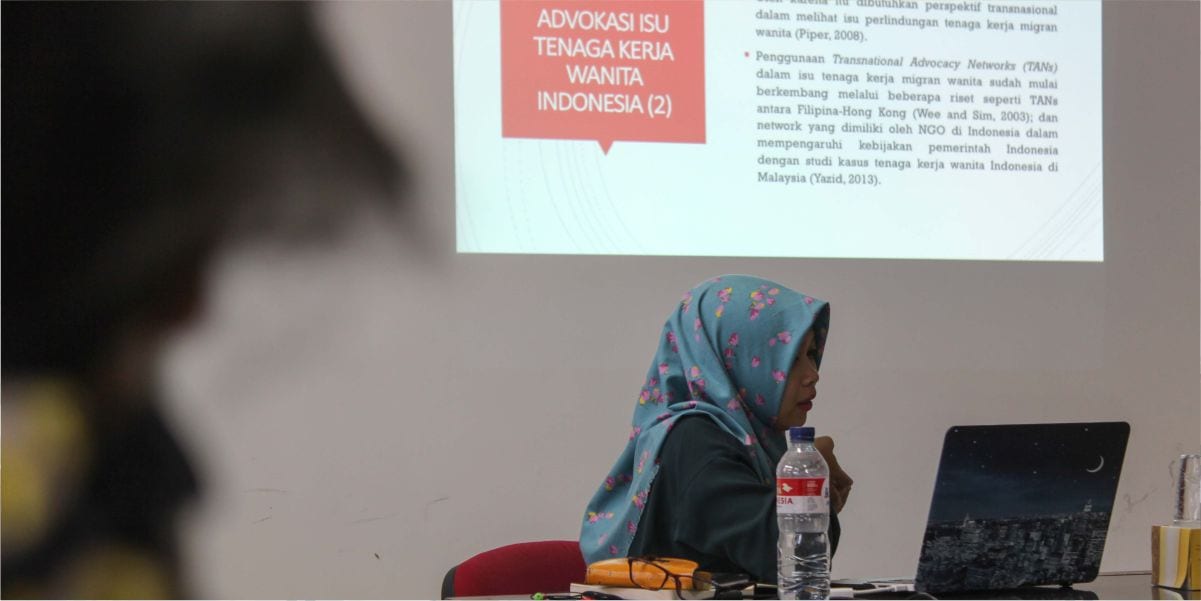
ASEAN Studies Center UGM held the seventh Bincang ASEAN which discusses some problems that Indonesian migrant workers face in several countries. This discussion is triggered by the recent problems regarding the migrants’ workers. Ezka Amalia, a postgraduate student at Nagoya University, Japan, began the discussion by examining the history of the women migrant workers and the problem they face on a daily basis. She addresses the problems surrouding labor migration in the region, such as the feminization of migration and worker’s rights’ fulfillment, in which the workers mostly became the vulnerable due to their role as a low-skilled labor.
Asia is the region with the largest number of domestic workers, with Indonesia, the Philippines, and Sri Lanka being the largest sender country. According to the ILO 2013 data, migrant domestic workers are vulnerable to long hours (99%), not covered by workers law (61%), and do not have weekly resting rights (97%). Most of the problem originated from the lack of knowledge regarding the right of works in the respective countries.

Ezka noted that most of the governments are still focused on controlling the migrants labor instead of protecting the migrant labor rights. Female migrant workers are not a citizen (in the recipient country). On the other words, they are marginalized citizens, which makes the recipient’s countries feel no need in addressing the problems immediately. There is also a heated debate as to whether Hong Kong government (which is autonomous from the mainland China) and the agency should fulfill the rights of migrant workers, which is yet to reach a conclusion. Women migrant workers have yet to understand their guaranteed rights in employment law.

Ezka also highlighted the nature of the migration of transnational female workers, which is accompanied by advocacy activities by NGOs and trade unions. She said that it needs to be involve all of the international actors working in this issue. Therefore, a transnational perspective is needed in looking at the issue of the protection of female migrant workers

To date, the advancement towards the protection of the migrant’s workers are being made; the advocacy from the NGO namely Migrant CARE and a workers union, in Hongkong, for example, the women migrant workers formed Indonesian Migrant Workers Union (IMWU). She conclude that the protections of migrant workers still needs to be put into the heart of Indonesian government’s program abroad.  

ASEAN Studies Center Introduced at Groningen Fall Conference on Challenges of Governance in Southeast Asia and ASEAN

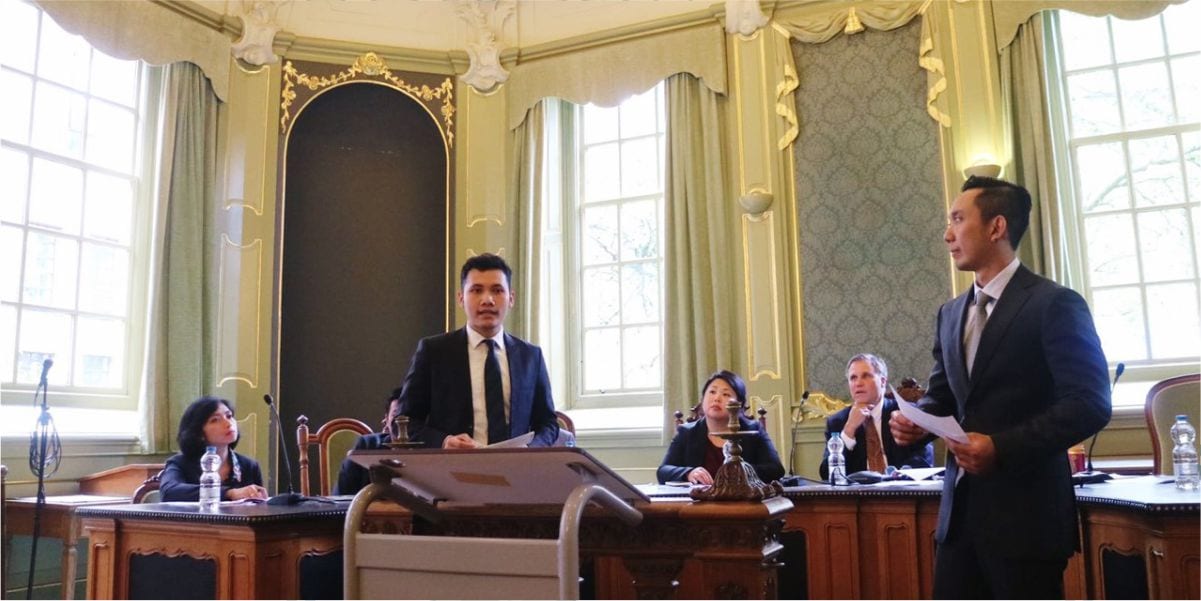
On Tuesday (12/9), M. Prayoga Permana and Dio Herdiawan Tobing, introduced ASEAN Studies Center (ASC) Universitas Gadjah Mada and its the newly established cooperation with Groningen Research Centre on Southeast Asia (SEA ASEAN) and ASEAN at the Centre’s Fall Conference on Challenges of Governance in Southeast Asia and ASEAN.
The conference was opened by an introductory speech from Prof. dr. Ronald Holzacker, the Executive Director of SEA ASEAN, noting that the aim of the conference was to present research findings of the centre’s Ph.D candidates whose research are surrounding most up-to-date topics of governance in Southeast Asia.

The conference was attended by the Ambassador of the Republic of Indonesia to the Kingdom of the Netherlands, I Gusti Agung Wesaka Puja and the Embassy’s Education and Cultural Attache, Bambang Hari Wibisono.

Furthermore, the conference was divided into three tracks, which consists of Economic Challenges to Development in Southeast Asia and Regional Integration, Spatial Challenges to Development in Southeast Asia, and Political, Social, and Legal Challenges to Development in Southeast Asia and Regional Integration.

In the conference, M. Prayoga Permana, the Former Director of ASC and Lecturer at the Department of Public Policy and Management UGM began his presentation by explaining how the two universities agreed initiate collaboration in the field of research, conferences, and student exchanges.

Following his presentation, Dio Herdiawan Tobing, ASC’s Former Research Manager and currently LL.M Student in Leiden University, introduced the ongoing projects initiated by both research centers. He pointed, “we are currently working on a research project covering the ASEAN haze agreement in Southeast Asia, an international working conference which will be held next month, and a book launch which scheduled to happen in November 2018″.

The international working conference will carry a theme of Regional and National Approaches toward the Sustainable Development Goals in Southeast Asia and ASEAN, taking place at the Faculty of Social and Political Sciences, Universitas Gadjah Mada on 3-5 October 2017.

Lastly, the conference was then followed by presentations from SEA ASEAN’s Ph.D. candidates in regards to their dissertation research findings.


Indonesia’s refugee policy – not ideal, but a step in the right direction

Dio Herdiawan Tobing

The Indonesian government needs to expand a presidential decree to protect refugees, by turning it into law. The definition the decree uses should also be broadened because it leaves out those fleeing disasters, instead referring only to those fleeing persecution.

In December 2016 president Joko Widodo filled a long legal vacuum by issuing a decree to ensure refugees not be arbitrarily expelled or returned to their country of origin.

Some researchers have criticised the decree for not doing enough to protect refugees. For example, Indonesia still hasn’t signed the 1951 Refugee Convention which outlines the rights of refugees and the obligations of governments to protect them.

The decree doesn’t set out ways that asylum seekers and refugees in Indonesia – some 13,800 people, mostly from Afghanistan and Myanmar – can be protected and settled in Indonesia through integration programs.

Nevertheless, this regulation shows a policy shift in Indonesia from a security approach that pays no regard to the safety of refugees into one that honours a customary international law obligation of non-refoulement, or not expelling or returning refugees.

Ignoring customary international law

Even though Indonesia is not a signatory to the 1951 Refugee Convention, its honour bound to the principle of non-refoulement. It’s considered a customary law that binds all countries, including those who are not signatory to the refugee convention. This means other countries observe it as law, even though its unofficial.

Violating this customary law would bring criticism and condemnation from other nations. Even now, the international community and civil society organisations have been pressuring the Indonesian government to sign the 1951 Refuge Convention.

Prior to the release of the decree, the Ministry of Law and Human Rights’ Directorate General of Immigration had been relying on their own standard operating procedures.

This directorate is the government lead in responding to refugee issues. Without any regulation on how to treat and manage refugees and asylum seekers, officials usually ignore the requests of refugees or detain those without UNHCR refugee identification cards. The immigration agency also does not differentiate between asylum seekers, refugees, or the stateless.

Without a UNHCR refugee identification card refugees are labelled illegal immigrants. And in order to get a UNHCR identification card, asylum seekers and refugees must go through a very long Refugee Status Determination (RSD) process. This process is a very exhausting, the waiting period alone for registration for a first interview ranges from 8 to 20 months.

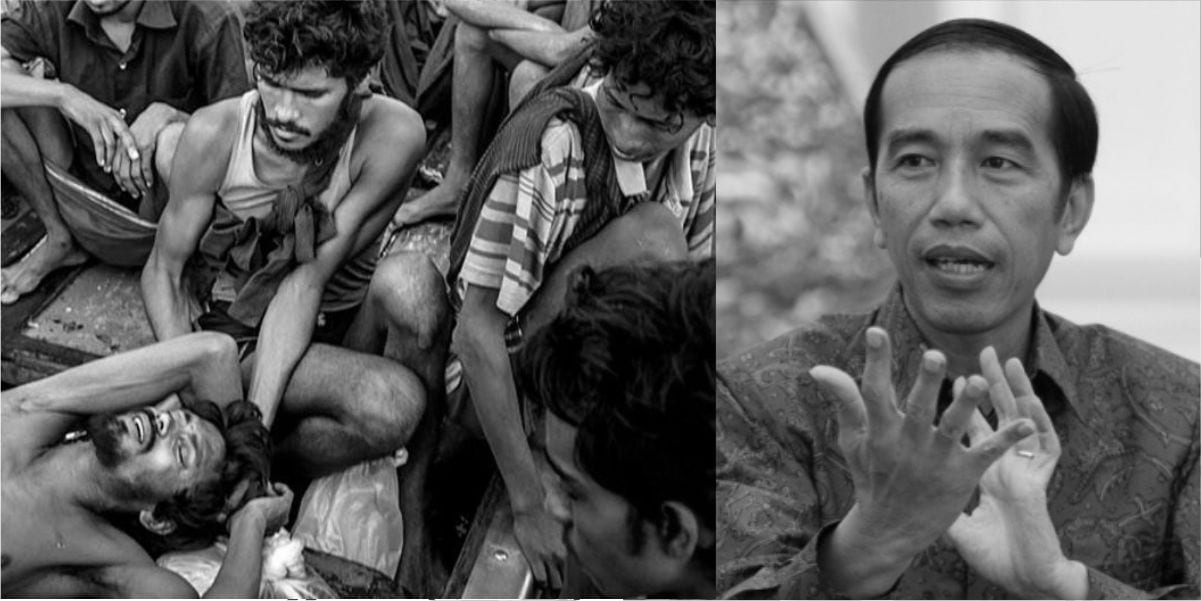
The lack of action in relation to refugees was most evident during the Andaman Sea Crisiswhen thousands of Rohingya and Bangladeshis were languishing at sea off Indonesia’s northernmost province Aceh in 2015.

The governments of Indonesia, Malaysia and Thailand initially refused to save them. Only after local fishermen saved the adrift themselves did Indonesia and Malaysia give them shelter.

The next year, Indonesia reportedly towed a stranded migrant boat in Aceh back to sea. In any case, immigration authorities would arrest refugees entering Indonesian territory.

However, the Indonesian Foreign Affairs Ministry showed a different approach. The ministry, with its clear understanding of international treaties and laws, is more active in responding to refugees. For example, Indonesia’s foreign minister Retno Marsudi has sent humanitarian aid for the Rohingya refugees. She visited two refugee camps of Rohingyas in Ukhia of Cox’s Bazar, Bangladesh.

Shifting refugee policy

President Widodo’s decree shows the progress Indonesia has made in adhering to international refugee law. Indonesia now has clear leadership on how to treat refugees. This means the differences in perception and behaviour between ministries can now be avoided.

Through this decree, Indonesia has codified the principle of non-refoulement into its new policy. It also makes Indonesia a pioneer among transit countries in Southeast Asia in policymaking on refugee issues.

Indonesia, Malaysia and Thailand are the primary refugee transit countries in Southeast Asia. To this date, only Indonesia has formulated a decree on refugees.

As Indonesia begins to enforce this refugee decree, Indonesia should also promote the values enshrined, in the region. Through diplomacy and negotiation, this may be a step to realise a refugee framework in Southeast Asian region and especially in the Association of Southeast Asian Nations or ASEAN.

This article was firstly published on theconversation.com


Dio Herdiawan Tobing is our former Research Manager. Dio currently studying his LLM in Public International Law at Leiden University.