Malaysia’s Chairmanship and Civil Society Engagement in ASEAN

Malaysia Prime Minister's Palace

Malaysia Prime Minister’s Palace

Ahmad Rizky M. Umar, Researcher, ASEAN Studies Centre, Universitas Gadjah Mada, Indonesia

As Myanmar’s chairmanship in ASEAN will be ended this year, we are now looking forward to transfer the chairmanship to Malaysia next year. Malaysia will host ASEAN Summit as well as most of regional forum in ASEAN.

In line with the ‘formal’ processes, Malaysia will also host the annual ASEAN People’s Forum/ASEAN Civil Society Conference (APF/ACSC). In this forum, many civil society organisation will gather, discuss, and announce their positions on emerging regional issues in Southeast Asia, including ASEAN.

Nect year’s ASEAN People Forum will be important for two reasons. First, we are getting closer to ASEAN Community, which will be established by 2015. The forum will determine how ASEAN civil society consolidate themselves to respond the upcoming ASEAN Community.

Second, this forum is important to prove whether ASEAN can be a ‘people-oriented’ organisation, as recently acclaimed by the Charter since 2007. If ASEAN want to be consistent with this jargon, it should be able to connect its people with the state and widening participation from grass-roots in the formal decision-making processes.

Since 2003, ASEAN has been institutionalised into a more complex form of regionalism. There has been three community inside ASEAN, which are aimed to be established by 2015 –ASEAN Political Security Community, ASEAN Economic Community, and ASEAN Socio-Cultural Community.

From year to year, the institutionalisation is getting more complex. For example, ASEAN has made a new regional Human Rights regime with the establishment of ASEAN Intergovernmental Commission on Human Rights (AICHR) and ASEAN Human Rights Declaration. This similar trend has also happens in other sectors, particularly in economic sectors.

However, in the other side, recent institutionalisations in ASEAN have also created a bureaucratic-technocratic tendency within the Association, particularly in the form of ASEAN Secretariat. Within this institution, ASEAN decision-making process is incorporated in a bureaucratic platform, which leaves only a little room for people’s participation.

This phenomenon leaves a critical question: is there any room for civil society to participate and getting involved in ASEAN decision-making process? If ASEAN is acclaimed as ‘people-oriented’ organisation, how ‘people-oriented’ is it in terms of people’s participation?

The ‘people-oriented ASEAN’ will be proven true if it open chances to speak, participate in decision-making process. In terms of participation, we have to consider participation not only in terms of ‘formal’ or ‘instituionalized’ participation, but also how the ‘subaltern’ –those who are marginalized and not able to politically express themselves— speak.

As we are getting nearer with the upcoming ASEAN Community, which is aimed at gathering all Southeast Asian countries to a ‘people-oriented’ regionalism, this problem should be taken into account.  Without creating spaces for any interest group to speak, we will only have an ‘elite-driven’ ASEAN which is, of course, not ‘people-oriented’ at all.

The ASEAN People Forum (formerly ASEAN Civil Society Conference), which is held annually as side programs of the Summit, can be an alternative room for the people to speak. Firstly launched in 2005, this forum was organised by Non-Governmental Organisations under SAPA to create a new ‘alternative regionalism’ in Southeast Asia (Chandra, 2009).

At the beginning, the Conference has been greeted by ASEAN Leaders. Malaysia, as the host of ASEAN Summit 2005, facilitated the forum in Universiti Teknologi Mara and invited the Conference’s representative to the Summit to present the result before the Summit. It was a good beginning.

However, as the time slowly passes by, relations between NGOs and ASEAN leaders weakened. There is still no room allocated for civil society to engage in decision-making process, particularly at the summit.

For example, as has been pointed out by Kelly Gerard (2014), several civil society organisations from Cambodia and Myanmar has been rejected by the government. Many decisions also ended up as policy recommendation, because there is no room for civil society’s representative to engage at the summit.

Thus, there has been a paradox. While ASEAN aims to create a ‘people-oriented ASEAN’, or, according to Amitav Acharya, ‘creating a participatory regionalism’, the decision making process at ASEAN itself has been closed for its society.

It becomes a main problem in ASEAN today. If we still want to build a ‘people-oriented’ ASEAN, the upcoming ASEAN People Forum should be able to deal with that. ASEAN People Forum cannot be a ‘talk shop’ anymore; the result should be progressive. I hereby proposed two steps to resolve the problems.

Firstly, making the ASEAN People Forum as a place for dialogue between the ASEAN Leaders and the ASEAN People –not only civil society, but also other interest group or minority entity in Southeast Asia. The organiser should invite the ASEAN Leaders –or high-ranking officials in ASEAN Secretariat—to make sure that the result of this forum is heard by ASEAN Elite Ranks.

Secondly, building some institutional hubs to accommodate people’s aspiration in  ASEAN decision-making processes. The ASEAN People Forum is not enough to accommodate ASEAN People’s interest, so that it should be widened through the creation of an ASEAN Parliament, to make sure that the the people can speak and be represented in ASEAN.

Thus, we shall welcome Malaysia’s chairmanship in ASEAN with a homework to make sure that the ASEAN people, including the subalterns, can speak and be heard by ASEAN Leaders. This homework is left to the participant and should be advocated more seriously.

I believe that if ASEAN People Forum can be more inclusive and dialogic, the Forum will not be an annual ‘talk shop’ anymore; even we can optimistically see a more ‘people-oriented ASEAN’ in the future. However, to make it worth, the participant should be more aware with people’s participation in the upcoming ASEAN Community.

The ASEAN People Forum 2015 should deliver a message –that the ASEAN People wants to be heard in the upcoming ASEAN Community. Thus, let the ASEAN People speak in Malaysia next year!

Whither ASEAN Centrality?

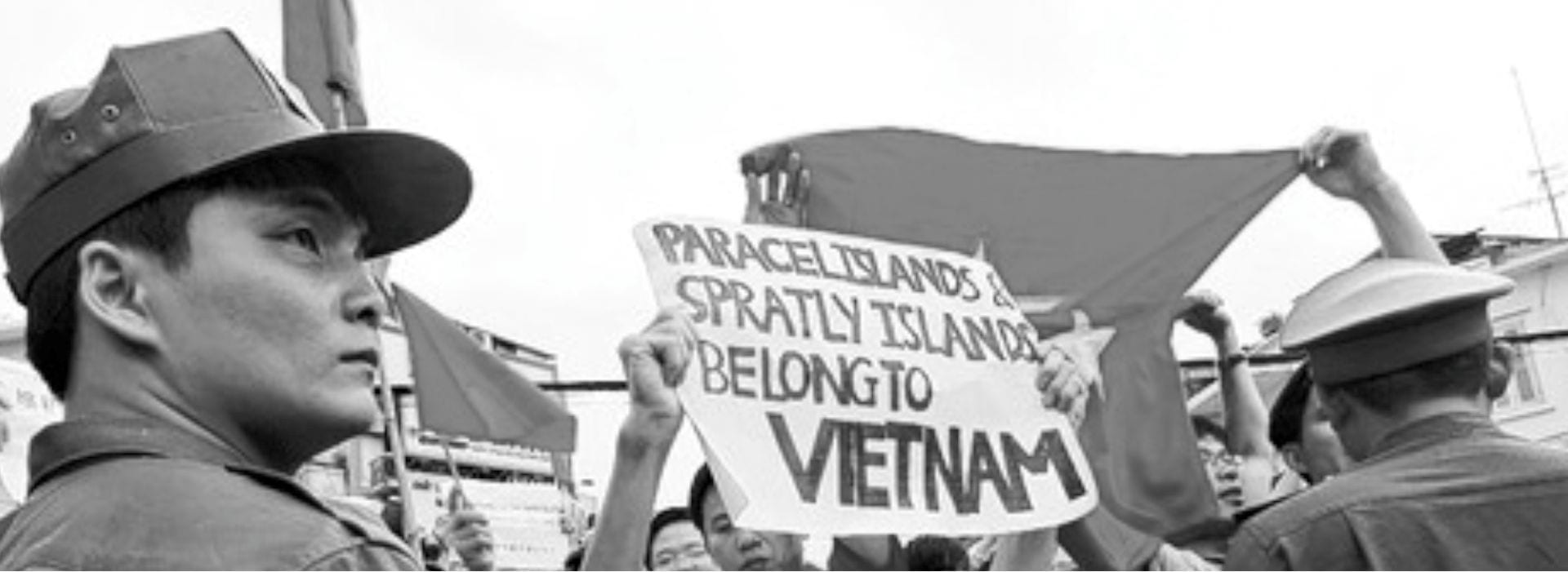
Protests against Chinese claims to territory in the South China Sea continued in Hanoi on Sunday, unimpeded by Vietnamese authorities. European Pressphoto Agency. Wall Street Journal

Protests against Chinese claims to territory in the South China Sea continued in Hanoi on Sunday, unimpeded by Vietnamese authorities. European Pressphoto Agency. Wall Street Journal

Ahmad Rizky Mardhatillah Umar, Research Assistant at ASEAN Studies Center, Universitas Gadjah Mada

The South China Sea dispute has been the main focus of this year’s ASEAN summit, which was held twice under Myanmar’s leadership. In a joint statement at the 24th and 25th ASEAN Summit, ASEAN leaders have expressed concerns over increased tension in South China Sea and further urged all parties to exercise restraint and avoid using ‘hard approach’ to deal with this problem.

Indonesia’s position is quite unique. Arif Havas Oegroseno has stated, at his articles, that Indonesia has no business in the South China Sea dispute and many observer’s endorsement to make Indonesia getting involved in this issue were misleading. However, Indonesia cannot avoid the conflict if the tension is raising, since it will heavily affect the regional security.

Former President Yudhoyono and Joko Widodo responded this issue in different manner. President Yudhoyono addressed the need of strengthening ASEAN Political Security Community at to handle security threats in the future. He spoke that ASEAN Community will be able to respond to those challenges without taking military actions.

However, Jokowi, without directly pointing to the South China Sea, spoke that maritime cooperation will be a priority on Indonesia’s foreign policy under his leadership.


The ‘China Threat’?

What happened in this year’s summit and the ASEAN Ministerial Meeting reflects the rise of ‘China threat’ among ASEAN member states. China has long placed its interests in Southeast Asia, given its geopolitical proximity.

Among the most prominent Chinese interest is the South China Sea. Geo-economically this sea provides oil and gas reserves as well as Islands. As of 2012, China controls several Islands around the sea, which leads to territorial disputes.

This decade witness a growing tension between China and several ASEAN member states over the sea. Vietnam is the most prominent state who has been in confrontation with China over the sea, along with the Philippines who has another problem.

We can interpret this South China Sea problem in two perspectives. Firstly, territorial dispute between China and ASEAN reflects China’s attempt to construct hegemony in Southeast Asia. By challenging several ASEAN Member States in the sea dispute, China will be able to define who are ‘friends’ and ‘enemies’ based on Bejing-defined national interest.

Secondly, the territorial dispute also reflects ASEAN’s lack of ‘common identity’ that leads to the absence of ASEAN single approach to deal with the problem. Although there has been the notion of ‘ASEAN Centrality’ in many talks on ASEAN Regionalism, in fact any issues were responded by each state’s foreign policy.

Since long time ago, ASEAN has failed to address many regional issues that involve external actors. This is not only happened South China Sea dispute. So far ASEAN was absence in many intraregional disputes, such as Thai-Cambodia or Indonesia-Malaysia border disputes.

Thus, within this perspective, South China Sea problem is in fact reflects ASEAN’s inability to solve political problems. Even though it has been widely criticized because of the more complex problem in the region, ASEAN’s quiet attitude towards conflict has found its root on the ‘ASEAN Way’ particularly the ‘non-interference’ norm which respects ASEAN member state’s souvereignty.

It is true that ‘non-interference’ norm can avoid can protect the souvereign rights of ASEAN Member States in managing their domestic environment. However, with the rising tension in South China Sea between China and the Philippines, the relevance of this norm in shaping ASEAN’s relations with other external forces shall be brought into question.

To this extent, we can raise a question: how can ASEAN resolve such political conflicts with ‘non-interference’ norms, while China and other political forces seemed to be more expansionists these days?

I argue that ASEAN should ease its ‘statist’ position over several serious international problems. It is important not to overemphasize the ‘non-interference’ norm when dealing with such problems that threaten regional environment. So far non-interference norm has proven to be an obstacle in dispute settlement in ASEAN, including in South China Sea.

In accordance to President Yudhoyono’s endorsement of ASEAN Political Security Community as main card to deal with international problems, it is important for ASEAN to create a more progressive foreign policy approach that directs every negotiation with external forces.


Bringing ‘ASEAN Centrality’ Back In

ASEAN Political Security blueprint (2009-2015) has stated that ASEAN seeks to strengthen ASEAN proactive role and centrality in a regional architecture that is open, transparent and inclusive while remaining actively engaged, forward-looking, and non-discriminatory.

To this extent, ASEAN should be regarded in the future as a regional institution, not only a group of state in region, thus bringing a more strategic approach to open dialogue and negotiation with other external forces. In this sense, ASEAN needs a specific foreign policy doctrine that can strategically respond challenges regional and international problems.

Thus, ‘ASEAN Centrality’ shall be recalled in order to minimize the conflict. Bringing the ‘ASEAN Centrality’ back in means that ASEAN shall have a more flexible approach to deal with regional issues and ASEAN member states shall involve regional institutios or norms to deal with this problem. On the other words, ASEAN need a ‘common foreign policy’ to deal with South China Sea issue.

There have been many approaches that can be transformed into a more progressive foreign policy approach in ASEAN. For example, in 1990s, Thailand’s Foreign Minister Surin Pitsuwan embraced ‘flexible engagement’ concept as a formula in managing ASEAN’s relations with other states. This concept was rejected –because some states feel that ASEAN should not tamper its non-interference rule— but is in fact more progressive than the traditional ‘ASEAN Way’ approach.

Surin’s proposal, at that time, was to include ASEAN in any negotiations that affect regional stability and dynamics. According to his explanation, if a dialogue partner pursues economic policies that ASEAN perceives as detrimental to its interests, it should be within ASEAN’s rights to call for changes in that policy.

There are also many other concepts, besides Surin’s flexible engagement’, that can be proposed as an alternative for ASEAN to deal with rising international problems. We should consider other ideas from Brunei or other Southeast Asian states to make sure that ASEAN can be truly served as ‘people-oriented’ community.

To welcome the upcoming ASEAN Community, it is important for ASEAN leaders to modernize ASEAN institutional framework by having a specific doctrine on its post-2015 foreign policy. Failure to do so will prevent ASEAN to strategically address territorial disputes in South China Sea.