Making ASEAN Democratic

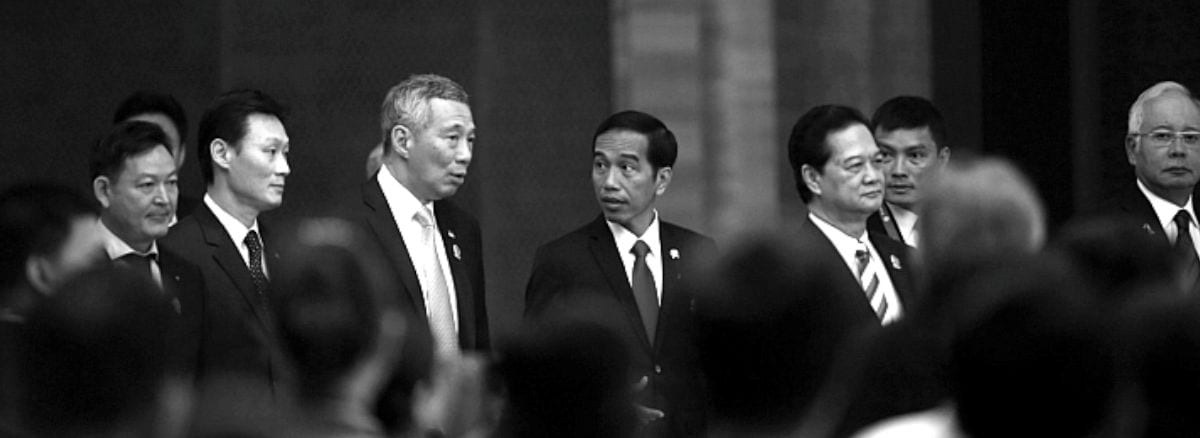
25th ASEAN Summit, Myanmar. Photo Credits: Strait Times

25th ASEAN Summit, Myanmar. Photo Credits: Strait Times

Ahmad Rizky Mardhatillah Umar, Research Assistant at ASEAN Studies Center, Universitas Gadjah Mada

ASEAN has held its 24th and 25th Summit in Myanmar this year. The latest Summit has just held this month, discussiong several important topic about ASEAN’s future, including those happened in South China Sea.

The ASEAN Summit is formally regarded as the highest level in ASEAN Structure. It means that the result of the summit will determine the future of ASEAN.

Thus, for ASEAN leaders, the ASEAN Summit is highly important to craft their own interests in Southeast Asia. It is not only a place to discuss important issues in building ASEAN Community (which will be established by 2015), but also an arena to negotiate state’s interest in the regional.

However, I doubt the issue will be concerned by the ordinary people who do not directly engaged with the ASEAN issues. Every year I regularly travel to Banjarmasin and Martapura (a fair town located in South Kalimantan) and rarely I hear any discussion about ASEAN in the public space, traditional market, or warung. ASEAN is still located outside of their minds –even the villagers have no idea what the ASEAN is.

The phenomenon portrayed an unresolved gap in ASEAN: while the ‘talk’ about regionalism is getting more complicated in the elite level, people’s perception about it is still very low. It is, as Amitav Acharya analysed, has been a main constraint to make a participatory regionalism in ASEAN.

Why do the people of ASEAN seem to be ignorant, or in other words, disengaged, with the ASEAN Summit that will direct this regional organisation in the future? John McCormick, in his popular book criticising the European Union, described this phenomenon as ‘democratic deficit’ –the lack of democracy that is generated by the inability of people to articulate their interests in decision-making process.

McCormick argued, following deliberative approach to democracy, that democracy is determined by people’s ability to influence the decision-making process. According to this approach, one can say a transnational governance model (like ASEAN) is democratic if it supports political participation from internal interest group within it.

Participation is central in deliberative democracy. To make a democratic or –to borrow a slogan— ‘people-centred’ ASEAN, the most important aspect that should fulfilled is maintaining participation from any interest group inside ASEAN Member States. In other words, we have to include regional Civil Society in ASEAN governing forum or institutions.

Since 2003, ASEAN has been institutionalised into a more complex form of regionalism. There has been three community inside ASEAN, which are aimed to be established by 2015 –ASEAN Political Security Community, ASEAN Economic Community, and ASEAN Socio-Cultural Community. According to deliberative approach, to make democratic ASEAN, these institutions should be openned for participation and engagement from civil society entities.

But in fact, the development of those institutions has turned into a bureaucratic-technocratic form within ASEAN Secretariats. Thus, we can see a new configuration within ASEAN decision-making process: the political decision will be discussed in a summit which is highly elitist and state-based, while the implementation of those decisions will be conducted in ASEAN Secretariat.

It has emerged a question: where was the space for civil society organisations to engage in ASEAN decision-making process? To respond the existed regime, some Non-Governmental Organisations launched ASEAN Civil Society Conference in 2005, which contained many NGOs in ASEAN Member States to participate and voice their interests in the forum.

At the beginning, the Conference has been greeted by ASEAN Leaders by inviting the Conference representative to the Summit to present the result before the Summit (Dang, 2008). However, as time passes by, relations between NGOs and ASEAN leaders weakened. There is still no room allocated for civil society to engage in decision-making process, particularly at the summit. The political decision still belongs to representative of the States.

Thus, the ASEAN Civil Society Conference –later changed as ‘ASEAN People’s Forum’— still left a gap: it is not adequate to accommodate people’s interests in decision-making process. The ASEAN People’s Forum is suitable to mobilise and consolidate interest group in Southeast Asia, but in the context of advocacy and engaging in decision-making process, there is no adequate room.

I argue that the lack of room for people’s participation in ASEAN is prominently caused by two variables. First, the elitist and state-centrist nature of ASEAN. Historically, ASEAN has been constructed by a consensus of state which was aimed to promote regional peace and stability as well as cooperate in social, economic, and cultural sectors. It is originally designed as a room for states, not people, to negotiate its interest in regions, and consequently makes the regionalism to be very state-centred.

Second, there is no significant effort from ASEAN Leaders to accommodate people’s participation in decision-making process. The 2003 ASEAN Summit only transformed ASEAN’s institutions (into Community) but not the decision-making process. It still lies on the hand of ASEAN leaders who attend the Summit. Thus, the state-centrist nature is still preserved until present and becomes a constraint for people’s participation in ASEAN.

To make ASEAN more democratic, on the context of the upcoming I hereby propose two steps. First, making ASEAN Summit as an inclusive meeting. This step can be conducted by allowing civil society organizations and interest groups to participate in the Summit, not only as observer but also as participant. The ASEAN Summit, therefore, should be perceived not only as an ‘arena of negotiation’ but also ‘place for dialogue’ between ASEAN leaders and its people.

Second, building some institutional bridge to connect ASEAN People and ASEAN leaders. It can be conducted through formalising ASEAN People’s Forum as a part of ASEAN Governing Institution, and then transform it as an influential institution in ASEAN decision-making process. Building a more representative institution as place for people’s representative is necessary, so that the people can articulate their interest in ASEAN.

I believe that if ASEAN leaders have a little political will to open more chances and opportunities for non-state actors to participate in the upcoming Summit, we can optimistically make a more democratic ASEAN in the future.

What Does Jokowi’s “Pro-People Diplomacy” Mean for ASEAN?

Retno Marsudi, Minister of Foreign Affaris, Republic of Indonesia. Source: progresivenews.com/

Retno Marsudi, Minister of Foreign Affaris, Republic of Indonesia.
Source: progresivenews.com/

By Ahmad Rizky Mardhatillah Umar, research assistant at ASEAN Studies Center, Universitas Gadjah Mada

Foreign Minister H.E. Retno LP Marsudi has launched her first speech on Indonesia’s Foreign Policy in Wednesday (29/10). At that speech, she embraced several new ideas on what she will do in her term as Foreign Minister and how Indonesia’s foreign policy will be directed under her leadership, including what is now popular as “Pro-People” Foreign policy.

Three important points are highlighted in her speech. Firstly, she acknowledges that strengthening Indonesia’s economy will be a priority in Jokowi’s administration. Therefore, Indonesia’s foreign policy should go side-by-side with economic development policy.

Secondly, Indonesia’s bilateral relations with strategic partners will be prioritized rather than takes part with multilateral forums. In other words, Marsudi seems to put aside Indonesia’s energetic movement in endorsing  multilateral talks and instead focusing on strengthening bilateral affairs.

Thirdly, she wants to reposits Indonesian diplomats not only as a negotiator abroad, but also as a ‘salesmen’ who takes part in promoting Indonesian products. Therefore, she insists that Indonesian diplomats should be able to do ‘blusukan’ in order to know what Indonesia has to be sold in international market.

Marsudi’s speech clearly indicates that Indonesia’s foreign policy, during Jokowi’s administration, will be served as a hub to strengthening economy in international level. Different with ‘Zero Enemy and Million Friends’ tagline brought by SBY administration, who aimes to posit Indonesia in global level, her ‘Pro-People Diplomacy’ seems to take inward-looking position in global politics.

This position can be understood by her intention to strengthen Indonesia’s bilateral relations rather than actively engage in multilateral forums, as well as making diplomacy as a means of enhancing economic development in international arena.

Nevertheless, we can also see that Marsudi’s speech has also sent a strong signal for the return of ‘national interest’ in Indonesia’s foreign policy. By crafting foreign policy with economic measure, Marsudi is not only abandoning SBY’s ‘million friends’ stance in international politics, but also she attempts to make Indonesia’s perspectives on global and regional environment firmer, that is to defend the state-defined national interest in his campaign.

Even though two previous ministers were also, to some extent, holding ‘national interest’ as a basis in foreign policy making, her stance in ‘national interest is quite stronger. During Hassan Wirayudha (2001-2009) ministerial period, Indonesia’s regional involvement is stronger. Wirayudha’s initiatives in ASEAN Political Security Community, as noted by Donald Weatherbee (2013), has made clear that Indonesia put ASEAN as a priority.

Not much different with Wirayudha, his successor Marty Natalegawa (2009-2014) also put Indonesia’s involvement in global level, particularly the South-to-South talks, as a priority in Indonesia’s foreign policy. His doctrine on dynamic equilibrium and peace doctrine was intended to support SBY’s vision on ‘Zero Enemy and ‘Million Friends’.

Compared with what Wirayudha and Natalegawa has done in previous years, Marsudi’s inward-looking approach will be less involved in positioning Indonesia in global and regional level. Her ‘pro-people’ approach will be focusing mainly on preparing Indonesia’s domestic economy to face economic integration in Southeast Asia.

Thus, what will this ‘pro-people’ stance, taken by Marsudi, implies to ASEAN, which aimed to be politically and economically consolidated after 2015?

Since the Second ASEAN Summit in Bali, 2003, Indonesia has been involved in integration processes in Southeast Asia. Indonesia has played important role in designing ASEAN Political Security Community as well as contributing in democratization in several states, thus contribute in driving political integration process in the region.

Former Foreign Minister Wirayudha spoke with at CSIS, Jakarta (24/10) that Indonesia has been actively provided intellectual leadership in ASEAN and it should be maintained in Jokowi’s administration.

With Foreign Minister Marsudi send the first signal on Indonesia’s foreign policy in the upcoming years, it will be interesting to see how Indonesia involve in regional politics. Given her pro-people approach in diplomacy, it can be predicted that there will be hope and concern from Marsudi to Indonesia’s position in ASEAN.

I will start with the hope. By taking a ‘pro-people’ approach with emphasis on economic diplomacy, Indonesia can be more prepared in facing the upcoming ASEAN Economic Community. With economic diplomacy, we can hope Jokowi’s administration can be more focused on developing Small and Medium Enterprises to deal with regional market.

ASEAN Studies Center, Universitas Gadjah Mada has mapped small and medium enterprises’ (SMEs) preparedness in ASEAN Community and it is found that many SMEs are not yet prepared to compete in regional level. Public should push Jokowi and his cabinet to be more serious in this issue.

However, we should also be concerned that ‘pro-people’ diplomacy can also make Indonesia’s leadership in several regional forums, particularly the ASEAN Political Security Community, will be weakened. So far Indonesia has driven several agenda in promoting democracy and human rights in the region.

By focusing on bilateral relations, Indonesia is less likely to continue its effort in becoming ‘the largest muslim democracy’ in the world that, to some extent, will implies on Indonesia’s passive stances in multilateral forums. Indonesia can also less involved with other multilateral groups such as G-20.

This concern shall be answered by our Foreign Minister Marsudi under her leadership. Indonesia should maintain the ‘ASEAN Centrality’ in dealing with regional issue, while strengthening bilateral relations with strategic partners.

Other than that, our foreign policy should also address many changes in global politics that will be occurred in the upcoming years, particularly with the political succession in the US which will influence Indonesia’s position among other states as well as Southeast Asian  politics.

Notwithstanding that, Marsudi’s innovative paces are still to be awaited in the future. Will she able to build a new style of leadership in the region is still the biggest challenge in the future. And most importantly, she is expected to make sure that ‘pro-people’ diplomacy can goes hand-in-hand with Indonesia’s intellectual leadership in ASEAN.

A new ASEAN community? Many already live it

Feature - Farish Strait Times

By Farish Ahmad-Noor, For The Straits Times

It is a question that may strike some as being somewhat simple: Where is Asean? However, the simplicity belies a deeper and more complex line of inquiry.

In reply, someone may simply pick up a map and point to the region designated as South-east Asia, and say, “There is where Asean is located”.

But is it? This leads us to ask: What is Asean?

Over the last few decades, the Association of South-east Asian Nations – as a multi-state pact of nation-states – has proven itself successful in many respects, from the prevention of war in South-east Asia to dealing with complex multilateral issues, ranging from cross-border pollution to the movement of Asean citizens to smuggling and terrorism.

These achievements, however, may pale in comparison to what may follow from next year, with the creation of the Asean Economic Community (AEC), a move that will bring about greater economic integration and cooperation.

As far as knowledge of the AEC is concerned, it would appear that not all the countries of Asean are equally prepared.

However, since 2012, Indonesia has begun to invest in think-tanks, departments and research centres in universities to promote the idea of Asean and the AEC, with one such being the newly minted Asean Studies Centre at the faculty of politics and social sciences at Gajah Mada University in Yogyakarta, Central Java.

These centres have been set up “to socialise”, or popularise, the concept of Asean and the AEC, in preparation for the changes ahead.

The Asean Studies Centre at Yogyakarta has conducted public awareness campaigns among workers and members of the public to inform them further about the importance of Asean and what the AEC can do for them.

Here lies the answer to “Where is Asean?”

For surely Asean – as a complex abstract idea – cannot simply lie in the buildings and institutions associated with its work, impressive though those buildings may be architecturally.

Complex ideas are not things that are embodied in non-sentient monuments, but rather embedded in the collective socio-psychological architecture of societies. Asean may be symbolised by objects like buildings, flags and logos, but as an idea, it is carried in the hearts and minds of people.


Giving life to an idea

SO WHAT would make Asean something real, and less of an abstract concept to people across South-east Asia?

Here we need to distinguish two processes: While Asean integration has been happening on a multi-state level, driven by governments and capital, centuries before Asean was even concocted, there was already the longer history of South-east Asian integration and social movement.

The latter is still evident today. Across many parts of South-east Asia, ordinary people continue to live as their ancestors have always done: Field-working researchers will tell you that in the waters of the region, nomadic itinerant communities like the Bajao Laut sea nomads still move across the archipelago with ease, and are spread across Indonesia, Malaysia and the Philippines.

Communities, such as the Dayaks of Borneo, straddle the political frontiers of both Indonesia and Malaysia, as do many cross-border communities in other parts of mainland South-east Asia.

When we speak about the “global age” of “cosmopolitan citizens”, we tend to focus more on urbanised elite communities, but we forget that along the border zones of the entire region, there remain communities who are hybrid, polyglot, who have multiple identities and who are just as comfortable with the reality of living in complex plural environments.

For millions of South-east Asians like them, the prospect of living in an integrated AEC is hardly new: Many of them already cross borders on a daily basis, and sometimes without passports or identity papers.

It is here that the connection has to be made, between the abstract idea of Asean integration and the realities of people who live in a South-east Asia that is intertwined and inter-connected. When bodies such as the Asean Studies Centre of Yogyakarta try to socialise the idea of Asean among ordinary Indonesians, they are rooting that abstract legal-political concept in the lived experience of people who will soon feel the impact of Asean economic integration, but who do not have the vocabulary to express it.

It provides them with the language and the means to understand the impact of multilateral arrangements upon their personal lives, and allows them to take part in that process and claim some ownership of it.

The reasons why this is so important at this stage are twofold:


The concept of a common home

FIRST, in order to give societies the means to appreciate and understand the processes of change as a result of closer Asean cooperation and integration, and to buffer against the possibility of a hyper-nationalist reaction against that process – should the inflow of capital and other influences from neighbouring countries be seen as “foreign” or “predatory”.

Second, to remind South-east Asians that living in an Asean economic community that is more inter-connected and inter-dependent is not a new or threatening thing, but in line with the history of movement, migration and investment in the region for hundreds of years.

Yet, many of us still do not know one another well enough: A glance at history textbooks used across the region will show that young South-east Asians may know more about the French Revolution or World War II than the history of the country next to theirs.

With the AEC almost upon us, the need to socialise and popularise the concept of Asean – and the notion of a collective belonging to South-east Asia as the common home to all in the region – is greater than ever before.

This has to be a comprehensive effort which extends beyond legislatures and debating chambers, and must reach the schools, streets and living rooms of the 600 million people who inhabit this part of the world.

And the end goal has to be the situation where the answer to “Where is Asean?” is “in me, and all of us”. For no amount of concrete or monuments can give life to Asean identity unless there are Asean-minded people who see the region as their home in the first place.

– – – – – – –

Farish Ahmad Noor is an Associate Professor at S. Rajaratnam School of International Studies (RSIS), Nanyang Technological University. This article first appeared in The Straits Times on 6 November 2014.

– See more at: http://www.straitstimes.com/news/opinion/more-opinion-stories/story/new-asean-community-many-already-live-it-20141106#sthash.TDfqGsEL.jB3F3ZhC.dpuf